GoGuides Technical White Paper v3.0
Machine-Readable Web Intelligence, Provenance, and Trust Infrastructure
Published September 15, 2026
Overview | Plain Text | Original PDF
Original PDF SHA-256: 64948170f044db30e7a4599cd3d0207b0b70231b1b93fbc3c741f838fecb1fd7
This page combines searchable text with visual renderings of the original PDF pages. The source PDF remains authoritative.
Page Navigation
Source PDF — Page 1
View original page 1 with figures and formatting
Searchable text
GoGuides | Web Intelligence - Provenance - Trust


                                                               GoGuides
                                                 WEB INTELLIGENCE | PROVENANCE | TRUST
                                        Observe the Web. Preserve the Evidence. Publish the Signal.


                   Machine-Readable Web Intelligence,
                   Provenance, and Trust Infrastructure
                                     Public Technical White Paper - Version 3.0 - September 2026


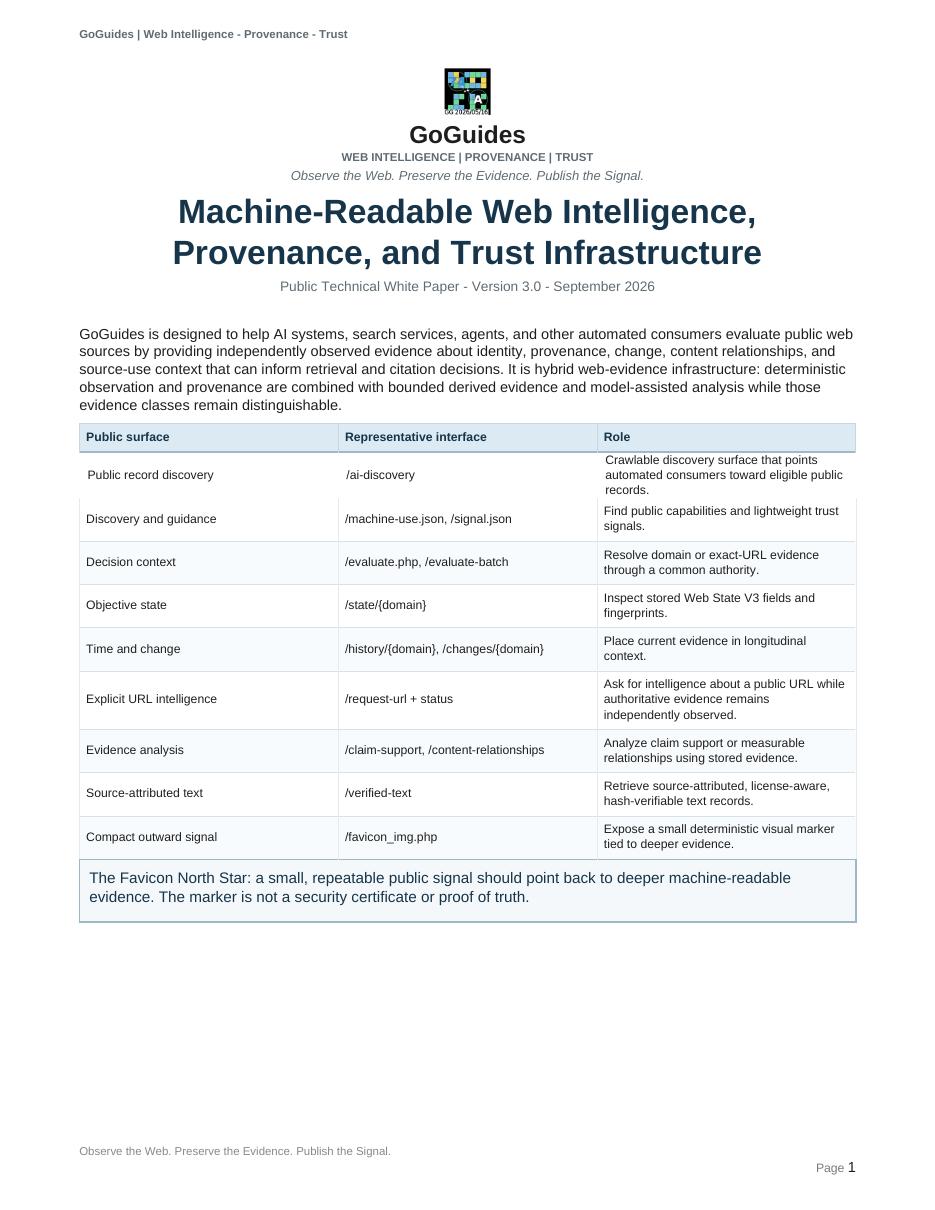
GoGuides is designed to help AI systems, search services, agents, and other automated consumers evaluate public web
sources by providing independently observed evidence about identity, provenance, change, content relationships, and
source-use context that can inform retrieval and citation decisions. It is hybrid web-evidence infrastructure: deterministic
observation and provenance are combined with bounded derived evidence and model-assisted analysis while those
evidence classes remain distinguishable.

 Public surface                                   Representative interface                  Role
                                                                                            Crawlable discovery surface that points
 Public record discovery                          /ai-discovery                             automated consumers toward eligible public
                                                                                            records.
                                                                                            Find public capabilities and lightweight trust
 Discovery and guidance                           /machine-use.json, /signal.json
                                                                                            signals.

                                                                                            Resolve domain or exact-URL evidence
 Decision context                                 /evaluate.php, /evaluate-batch
                                                                                            through a common authority.

                                                                                            Inspect stored Web State V3 fields and
 Objective state                                  /state/{domain}
                                                                                            fingerprints.

                                                                                            Place current evidence in longitudinal
 Time and change                                  /history/{domain}, /changes/{domain}
                                                                                            context.

                                                                                            Ask for intelligence about a public URL while
 Explicit URL intelligence                        /request-url + status                     authoritative evidence remains
                                                                                            independently observed.

                                                                                            Analyze claim support or measurable
 Evidence analysis                                /claim-support, /content-relationships
                                                                                            relationships using stored evidence.

                                                                                            Retrieve source-attributed, license-aware,
 Source-attributed text                           /verified-text
                                                                                            hash-verifiable text records.

                                                                                            Expose a small deterministic visual marker
 Compact outward signal                           /favicon_img.php
                                                                                            tied to deeper evidence.

 The Favicon North Star: a small, repeatable public signal should point back to deeper machine-readable
 evidence. The marker is not a security certificate or proof of truth.


Observe the Web. Preserve the Evidence. Publish the Signal.
                                                                                                                                     Page 1
Source PDF — Page 2
View original page 2 with figures and formatting
Searchable text
GoGuides | Web Intelligence - Provenance - Trust


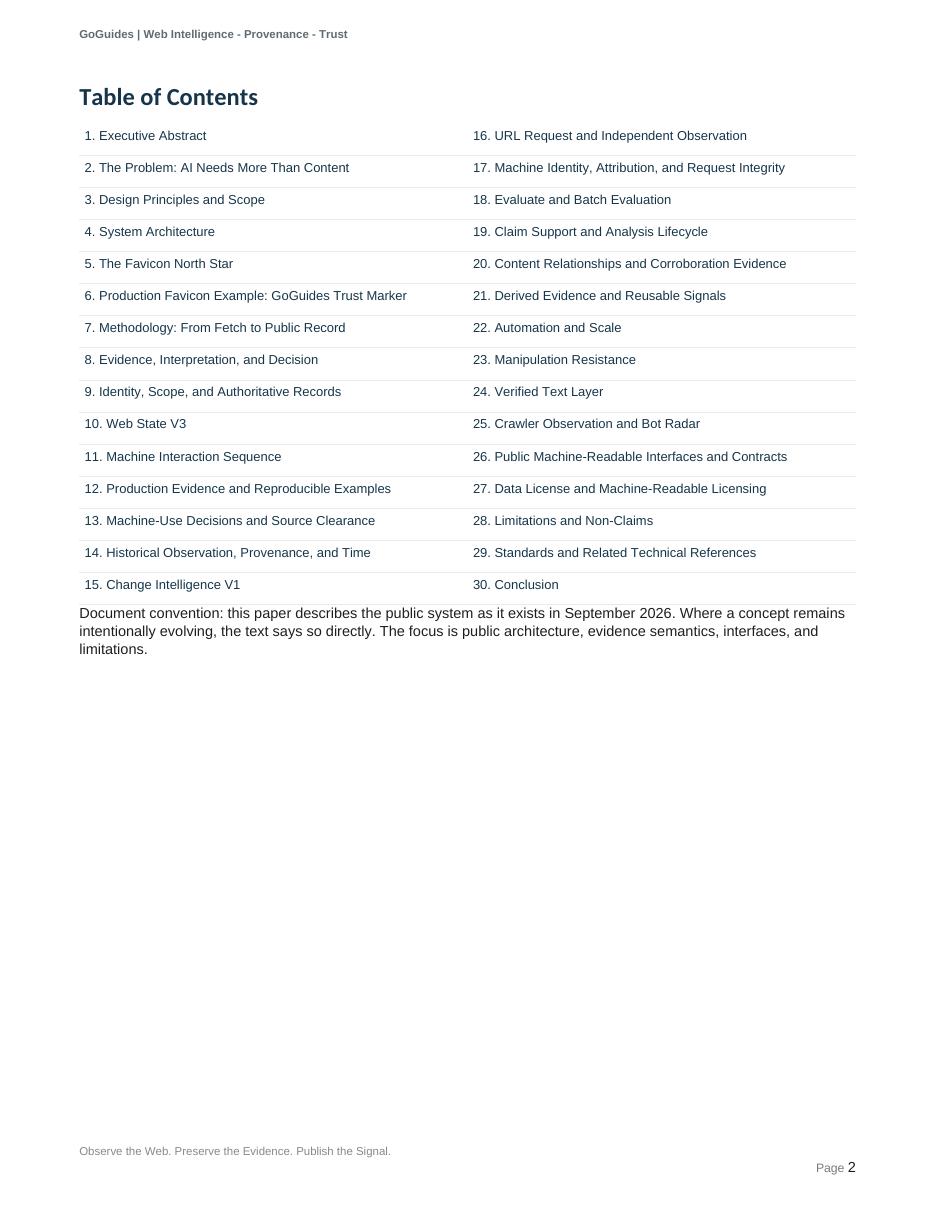
Table of Contents
 1. Executive Abstract                                        16. URL Request and Independent Observation

 2. The Problem: AI Needs More Than Content                   17. Machine Identity, Attribution, and Request Integrity

 3. Design Principles and Scope                               18. Evaluate and Batch Evaluation

 4. System Architecture                                       19. Claim Support and Analysis Lifecycle

 5. The Favicon North Star                                    20. Content Relationships and Corroboration Evidence

 6. Production Favicon Example: GoGuides Trust Marker         21. Derived Evidence and Reusable Signals

 7. Methodology: From Fetch to Public Record                  22. Automation and Scale

 8. Evidence, Interpretation, and Decision                    23. Manipulation Resistance

 9. Identity, Scope, and Authoritative Records                24. Verified Text Layer

 10. Web State V3                                             25. Crawler Observation and Bot Radar

 11. Machine Interaction Sequence                             26. Public Machine-Readable Interfaces and Contracts

 12. Production Evidence and Reproducible Examples            27. Data License and Machine-Readable Licensing

 13. Machine-Use Decisions and Source Clearance               28. Limitations and Non-Claims

 14. Historical Observation, Provenance, and Time             29. Standards and Related Technical References

 15. Change Intelligence V1                                   30. Conclusion

Document convention: this paper describes the public system as it exists in September 2026. Where a concept remains
intentionally evolving, the text says so directly. The focus is public architecture, evidence semantics, interfaces, and
limitations.


Observe the Web. Preserve the Evidence. Publish the Signal.
                                                                                                                         Page 2
Source PDF — Page 3
View original page 3 with figures and formatting
Searchable text
GoGuides | Web Intelligence - Provenance - Trust


1. Executive Abstract
Artificial intelligence systems, search crawlers, automated agents, and machine-learning systems increasingly consume
websites not only to index information, but to summarize, cite, recommend, classify, monitor, compare, and act on it.
The web was built primarily to publish content. Machine consumers need additional context: what GoGuides actually
observed, when it was observed, how the source has changed over time, which machine-facing policy artifacts were
present, whether a value was observed or asserted, whether apparently separate content is measurably related, and
whether a particular stored source supports a claim.
GoGuides addresses that problem with a layered public evidence system: independent observation, source identity and
provenance, decision-oriented evaluation, objective Web State, longitudinal history, Change Intelligence, Verified Text,
evidence-bound analysis, content-relationship evidence, and a deterministic favicon marker that points back to deeper
records.

 The central question is not simply "Can this page be read?" It is: What has been observed about this source,
 how may that evidence reasonably be used, what changed over time, and what should a machine inspect next?


GoGuides does not claim to prove that every statement on a website is true. Its contribution is narrower and more
testable: publish structured observations, explainable decision context, versioned derived evidence, and machine-
readable records without collapsing every signal into one simplistic trusted/untrusted label.

2. The Problem: AI Needs More Than Content
Reading content is not the same as knowing whether a source should be cited, recommended, used for a transaction,
relied upon for sensitive advice, treated as independent corroboration, or considered current enough for a particular task.
A source may be readable but not suitable for citation. It may be useful for general context but inappropriate for a higher-
risk action. It may be legitimate but newly observed. It may be stable, or it may have changed substantially since a prior
observation.

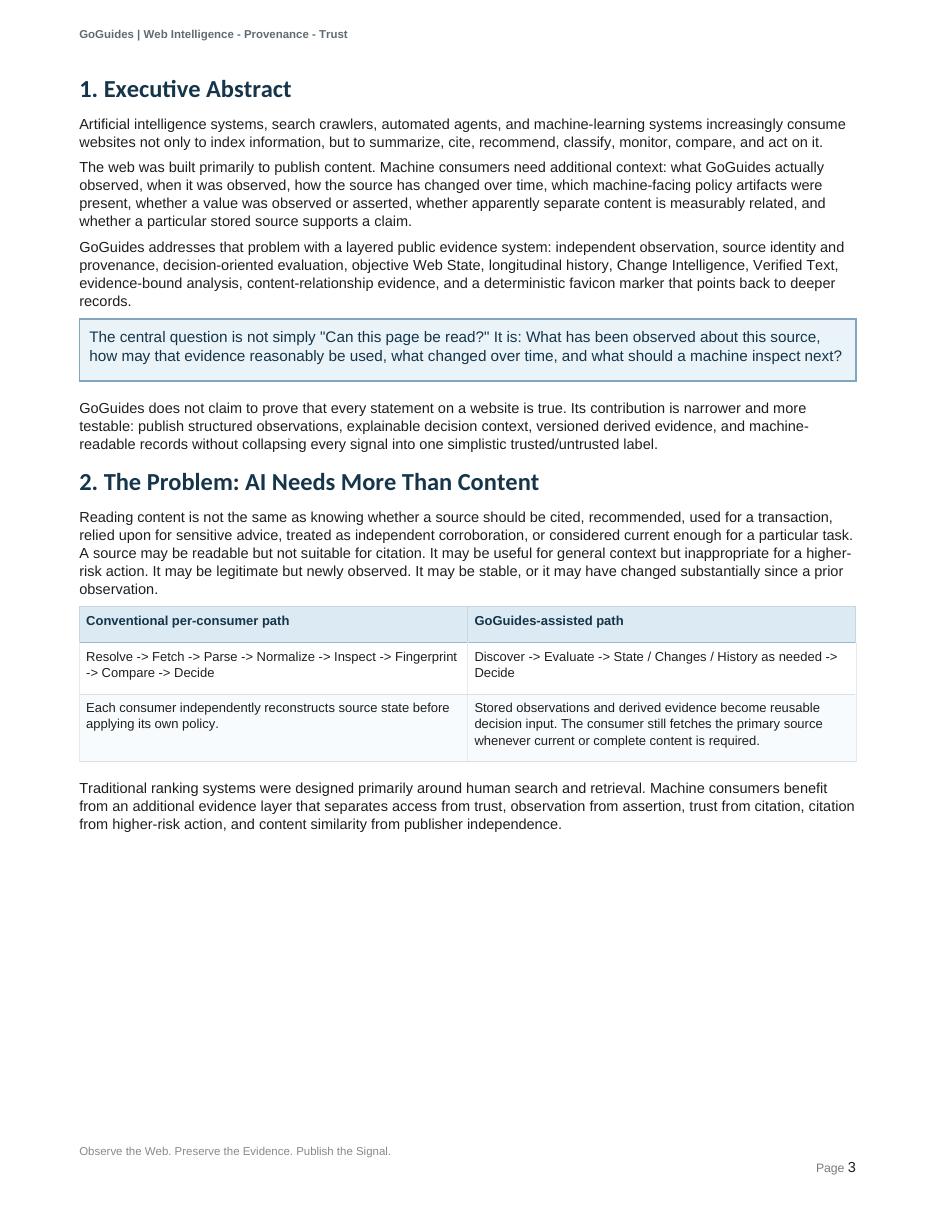
 Conventional per-consumer path                                     GoGuides-assisted path

 Resolve -> Fetch -> Parse -> Normalize -> Inspect -> Fingerprint   Discover -> Evaluate -> State / Changes / History as needed ->
 -> Compare -> Decide                                               Decide

 Each consumer independently reconstructs source state before       Stored observations and derived evidence become reusable
 applying its own policy.                                           decision input. The consumer still fetches the primary source
                                                                    whenever current or complete content is required.


Traditional ranking systems were designed primarily around human search and retrieval. Machine consumers benefit
from an additional evidence layer that separates access from trust, observation from assertion, trust from citation, citation
from higher-risk action, and content similarity from publisher independence.


Observe the Web. Preserve the Evidence. Publish the Signal.
                                                                                                                               Page 3
Source PDF — Page 4
View original page 4 with figures and formatting
Searchable text
GoGuides | Web Intelligence - Provenance - Trust


3. Design Principles and Scope
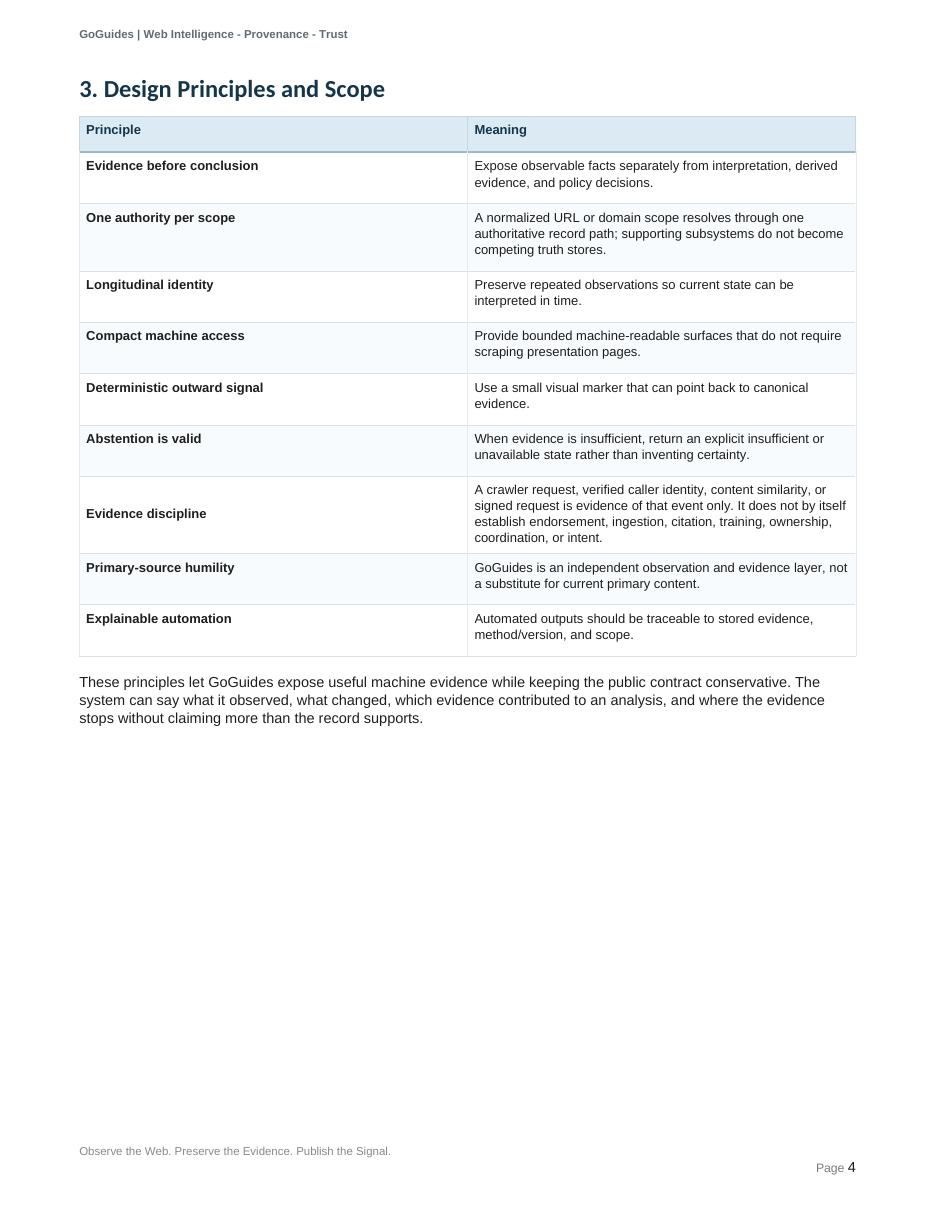
 Principle                                                    Meaning

 Evidence before conclusion                                   Expose observable facts separately from interpretation, derived
                                                              evidence, and policy decisions.

 One authority per scope                                      A normalized URL or domain scope resolves through one
                                                              authoritative record path; supporting subsystems do not become
                                                              competing truth stores.

 Longitudinal identity                                        Preserve repeated observations so current state can be
                                                              interpreted in time.

 Compact machine access                                       Provide bounded machine-readable surfaces that do not require
                                                              scraping presentation pages.

 Deterministic outward signal                                 Use a small visual marker that can point back to canonical
                                                              evidence.

 Abstention is valid                                          When evidence is insufficient, return an explicit insufficient or
                                                              unavailable state rather than inventing certainty.

                                                              A crawler request, verified caller identity, content similarity, or
                                                              signed request is evidence of that event only. It does not by itself
 Evidence discipline
                                                              establish endorsement, ingestion, citation, training, ownership,
                                                              coordination, or intent.

 Primary-source humility                                      GoGuides is an independent observation and evidence layer, not
                                                              a substitute for current primary content.

 Explainable automation                                       Automated outputs should be traceable to stored evidence,
                                                              method/version, and scope.


These principles let GoGuides expose useful machine evidence while keeping the public contract conservative. The
system can say what it observed, what changed, which evidence contributed to an analysis, and where the evidence
stops without claiming more than the record supports.


Observe the Web. Preserve the Evidence. Publish the Signal.
                                                                                                                             Page 4
Source PDF — Page 5
View original page 5 with figures and formatting
Searchable text
GoGuides | Web Intelligence - Provenance - Trust


4. System Architecture
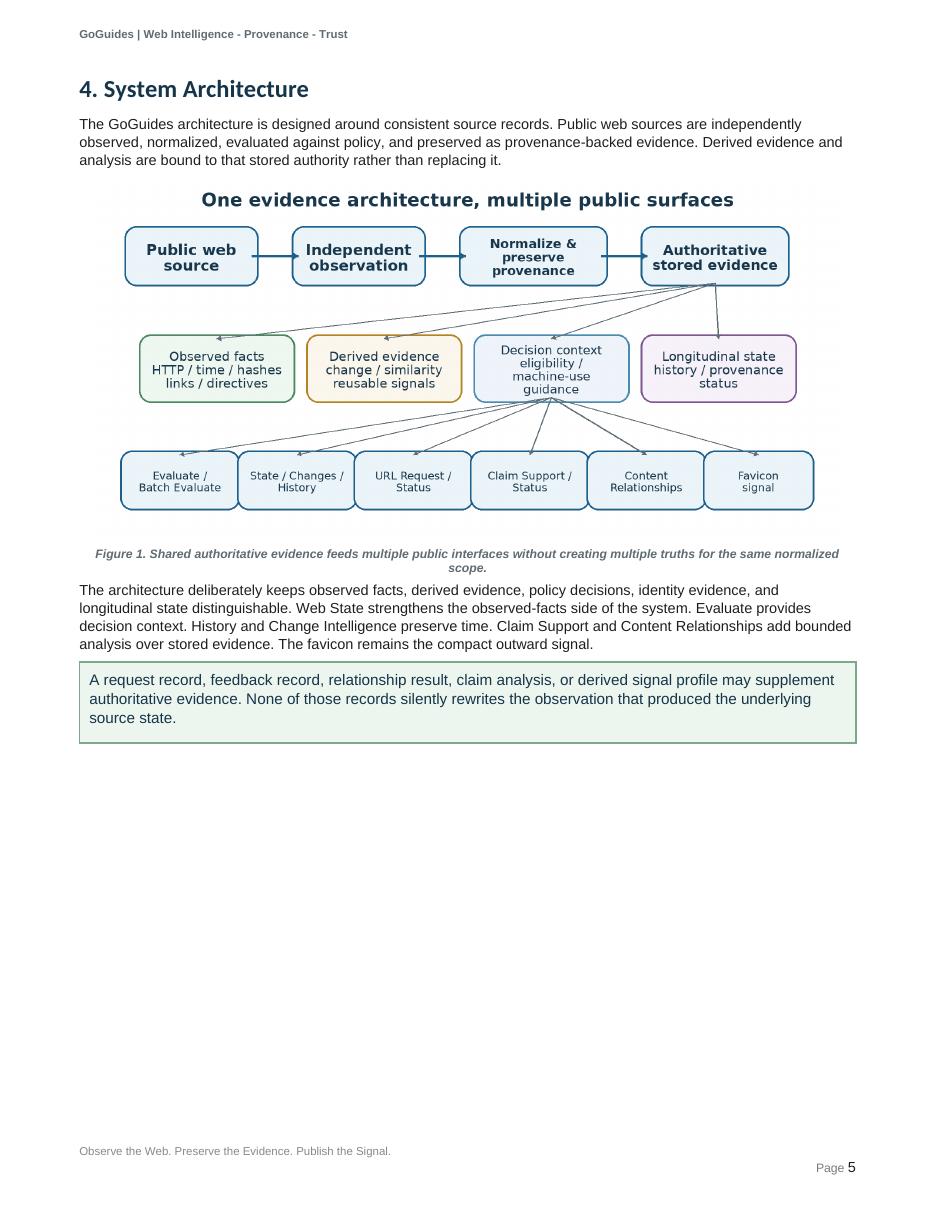
The GoGuides architecture is designed around consistent source records. Public web sources are independently
observed, normalized, evaluated against policy, and preserved as provenance-backed evidence. Derived evidence and
analysis are bound to that stored authority rather than replacing it.


   Figure 1. Shared authoritative evidence feeds multiple public interfaces without creating multiple truths for the same normalized
                                                                scope.
The architecture deliberately keeps observed facts, derived evidence, policy decisions, identity evidence, and
longitudinal state distinguishable. Web State strengthens the observed-facts side of the system. Evaluate provides
decision context. History and Change Intelligence preserve time. Claim Support and Content Relationships add bounded
analysis over stored evidence. The favicon remains the compact outward signal.

 A request record, feedback record, relationship result, claim analysis, or derived signal profile may supplement
 authoritative evidence. None of those records silently rewrites the observation that produced the underlying
 source state.


Observe the Web. Preserve the Evidence. Publish the Signal.
                                                                                                                                Page 5
Source PDF — Page 6
View original page 6 with figures and formatting
Searchable text
GoGuides | Web Intelligence - Provenance - Trust


5. The Favicon North Star
The GoGuides favicon is not a decorative add-on. It is the North Star of the system: a lightweight, deterministic visual
trust signal that can be embedded, requested, cached, compared, and monitored by both humans and machines. Each
marker is generated deterministically from supported GoGuides measurement inputs for the site, including AI Rank and
crawl timing. The same supported input state produces the same favicon output, so the marker is repeatable for a given
record state rather than arbitrary artwork.
A full API call is useful when a machine needs detail. But the open web also benefits from tiny signals. A favicon-sized
artifact can expose visible state changes without requiring every consumer to perform a heavy lookup. Because the
marker is generated from site- and state-specific measurements, GoGuides does not use one generic decorative badge
for every domain: each favicon is a visual representation of the corresponding GoGuides record state. When rank, grade,
crawl timing, date/state, seed, or another supported input changes, the visual artifact can change in a controlled way.


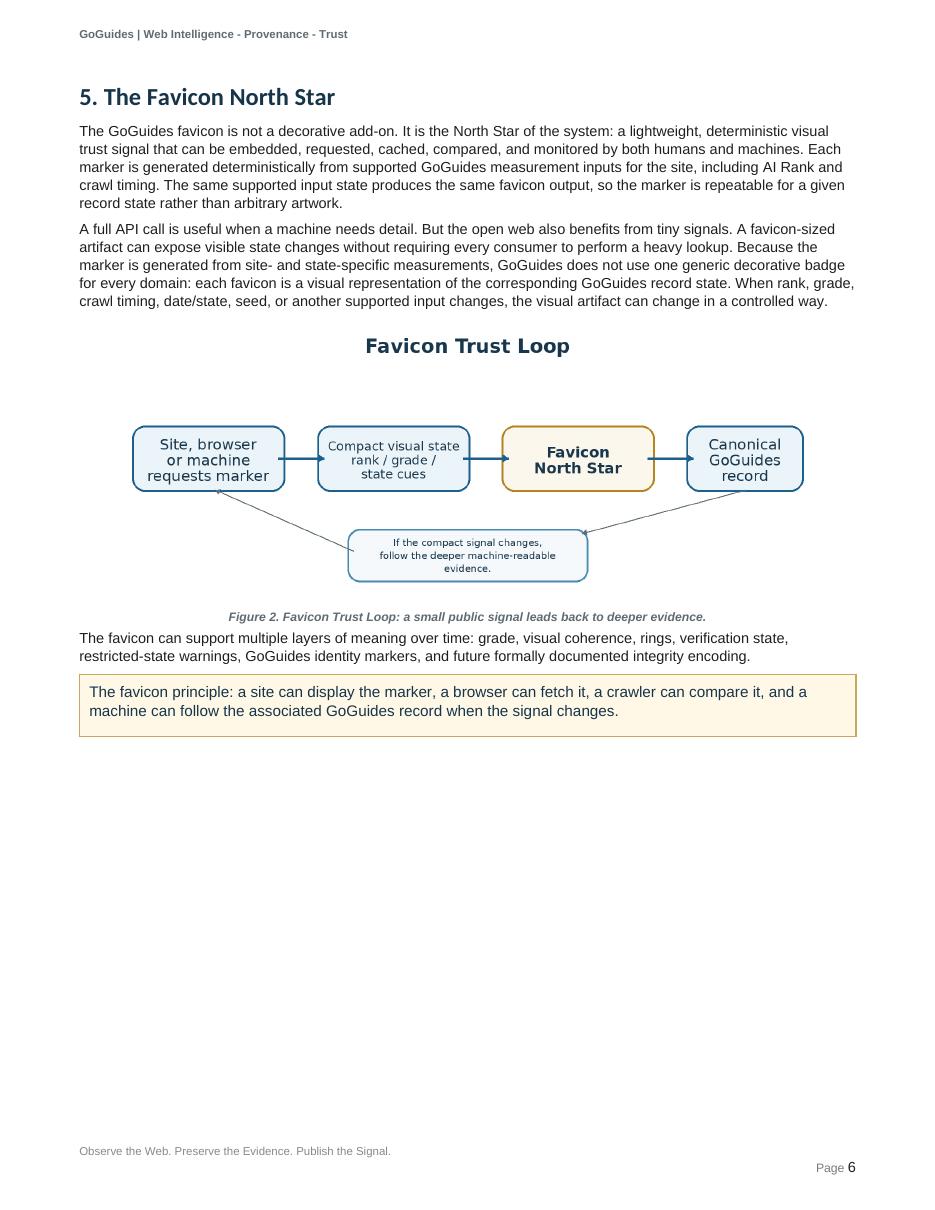
                            Figure 2. Favicon Trust Loop: a small public signal leads back to deeper evidence.
The favicon can support multiple layers of meaning over time: grade, visual coherence, rings, verification state,
restricted-state warnings, GoGuides identity markers, and future formally documented integrity encoding.

 The favicon principle: a site can display the marker, a browser can fetch it, a crawler can compare it, and a
 machine can follow the associated GoGuides record when the signal changes.


Observe the Web. Preserve the Evidence. Publish the Signal.
                                                                                                                    Page 6
Source PDF — Page 7

View original page 7 with figures and formatting
Searchable text
GoGuides | Web Intelligence - Provenance - Trust


6. Production Favicon Example: GoGuides Trust Marker
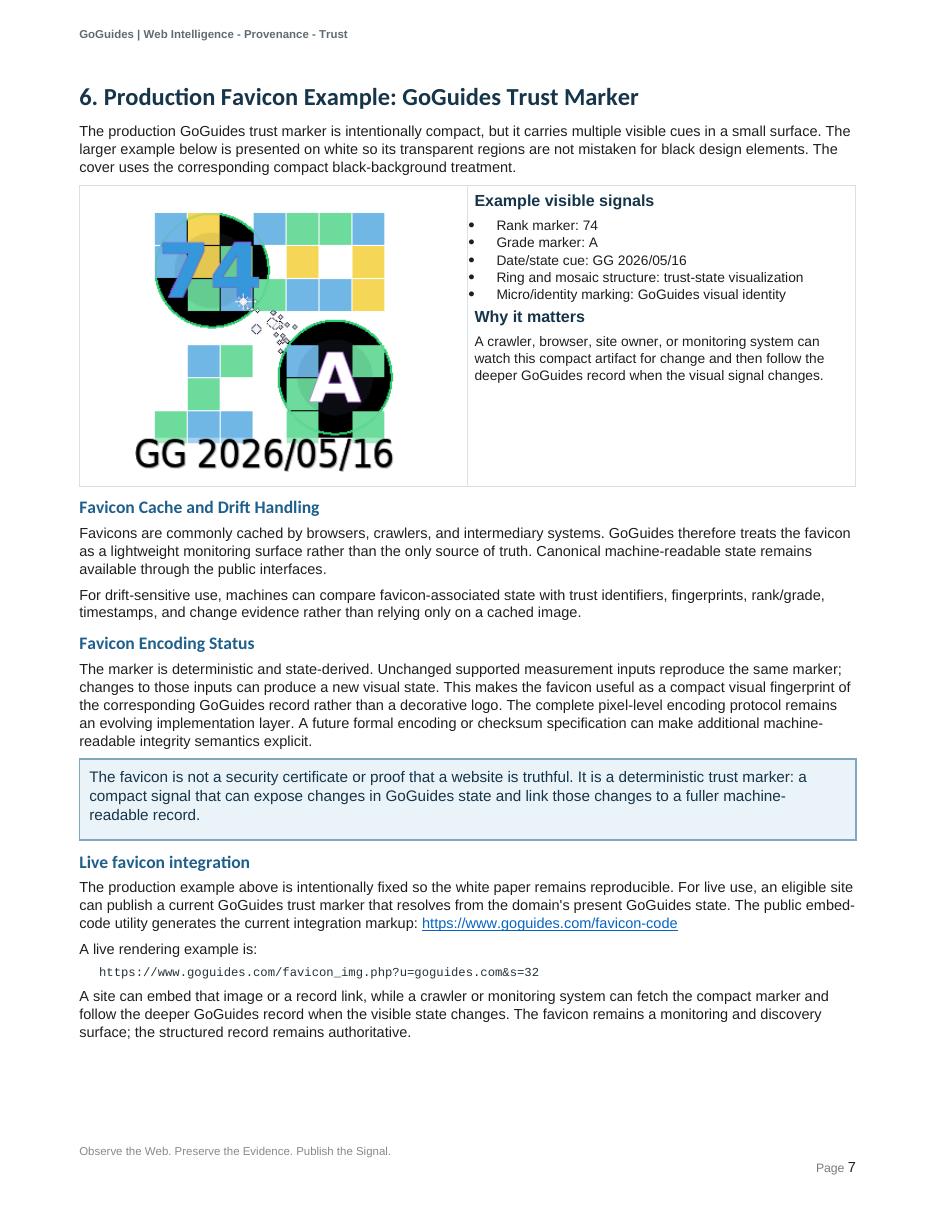
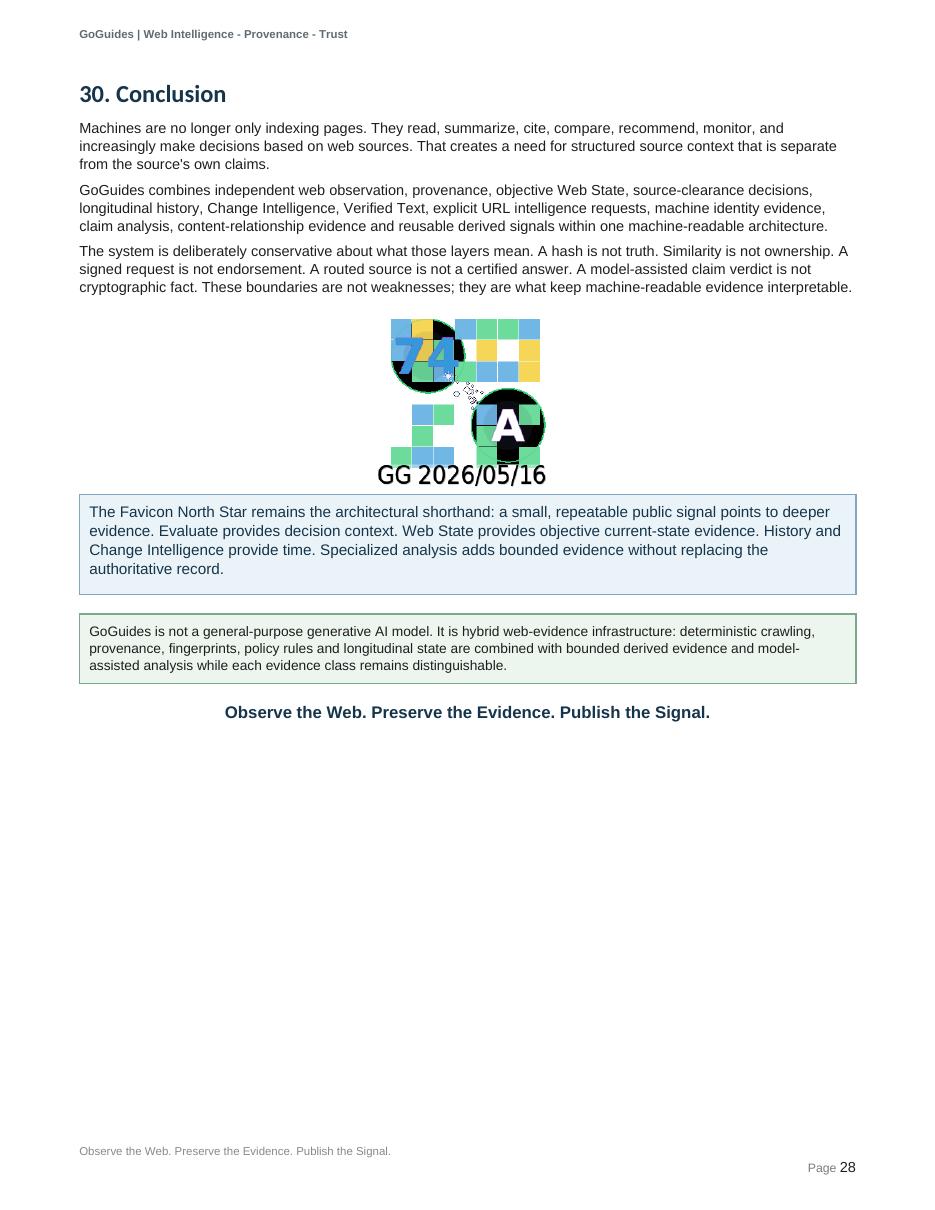
The production GoGuides trust marker is intentionally compact, but it carries multiple visible cues in a small surface. The
larger example below is presented on white so its transparent regions are not mistaken for black design elements. The
cover uses the corresponding compact black-background treatment.

                                                               Example visible signals
                                                              •    Rank marker: 74
                                                              •    Grade marker: A
                                                              •    Date/state cue: GG 2026/05/16
                                                              •    Ring and mosaic structure: trust-state visualization
                                                              •    Micro/identity marking: GoGuides visual identity
                                                               Why it matters
                                                               A crawler, browser, site owner, or monitoring system can
                                                               watch this compact artifact for change and then follow the
                                                               deeper GoGuides record when the visual signal changes.


Favicon Cache and Drift Handling
Favicons are commonly cached by browsers, crawlers, and intermediary systems. GoGuides therefore treats the favicon
as a lightweight monitoring surface rather than the only source of truth. Canonical machine-readable state remains
available through the public interfaces.
For drift-sensitive use, machines can compare favicon-associated state with trust identifiers, fingerprints, rank/grade,
timestamps, and change evidence rather than relying only on a cached image.

Favicon Encoding Status
The marker is deterministic and state-derived. Unchanged supported measurement inputs reproduce the same marker;
changes to those inputs can produce a new visual state. This makes the favicon useful as a compact visual fingerprint of
the corresponding GoGuides record rather than a decorative logo. The complete pixel-level encoding protocol remains
an evolving implementation layer. A future formal encoding or checksum specification can make additional machine-
readable integrity semantics explicit.

 The favicon is not a security certificate or proof that a website is truthful. It is a deterministic trust marker: a
 compact signal that can expose changes in GoGuides state and link those changes to a fuller machine-
 readable record.


Live favicon integration
The production example above is intentionally fixed so the white paper remains reproducible. For live use, an eligible site
can publish a current GoGuides trust marker that resolves from the domain's present GoGuides state. The public embed-
code utility generates the current integration markup: https://www.goguides.com/favicon-code
A live rendering example is:
   https://www.goguides.com/favicon_img.php?u=goguides.com&s=32

A site can embed that image or a record link, while a crawler or monitoring system can fetch the compact marker and
follow the deeper GoGuides record when the visible state changes. The favicon remains a monitoring and discovery
surface; the structured record remains authoritative.


Observe the Web. Preserve the Evidence. Publish the Signal.
                                                                                                                          Page 7
Source PDF — Page 8
View original page 8 with figures and formatting
Searchable text
GoGuides | Web Intelligence - Provenance - Trust


7. Methodology: From Fetch to Public Record
A GoGuides observation begins with a public web target obtained through discovery, scheduled revisit, or a public
request. The observation pipeline normalizes the target and applies network-safety checks before retrieval. It records
requested/final URL identity, HTTP outcome, timestamps, and other observable response properties.

 Stage                                                             Representative output

 1. Normalize and safety-check                                     Canonical target form; unsafe network targets rejected.

 2. Retrieve                                                       Requested URL, final URL, HTTP status, redirects, observation
                                                                   time.

 3. Extract and normalize                                          Normalized text, structured data, selected headers, links,
                                                                   robots/meta policy evidence.

 4. Fingerprint                                                    Text similarity fingerprint and SHA-256 fingerprints for selected
                                                                   normalized state.

 5. Describe state                                                 Word/link counts, schema mask, header fingerprint, policy mask
                                                                   and related observable state.

 6. Persist provenance                                             Observation identity, chronology, evidence, repeated-
                                                                   observation context.

 7. Resolve public record                                          Eligibility, machine-use context, State, History, verification
                                                                   context and compact signals.


The methodology is designed to make public claims traceable to evidence. Internal implementation controls are not part
of the public evidence contract and are not required to interpret the public record.

8. Evidence, Interpretation, and Decision


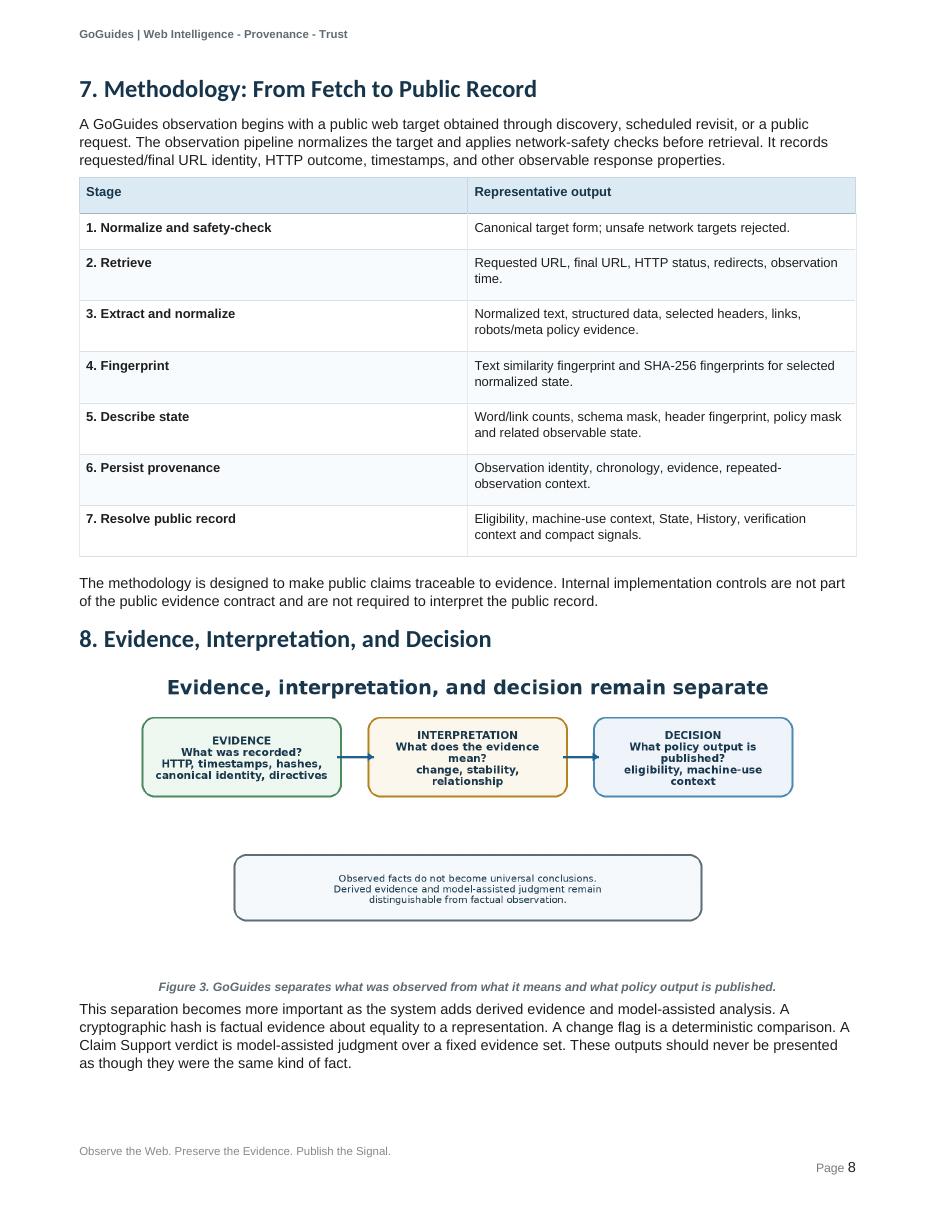
               Figure 3. GoGuides separates what was observed from what it means and what policy output is published.
This separation becomes more important as the system adds derived evidence and model-assisted analysis. A
cryptographic hash is factual evidence about equality to a representation. A change flag is a deterministic comparison. A
Claim Support verdict is model-assisted judgment over a fixed evidence set. These outputs should never be presented
as though they were the same kind of fact.


Observe the Web. Preserve the Evidence. Publish the Signal.
                                                                                                                                    Page 8
Source PDF — Page 9
View original page 9 with figures and formatting
Searchable text
GoGuides | Web Intelligence - Provenance - Trust


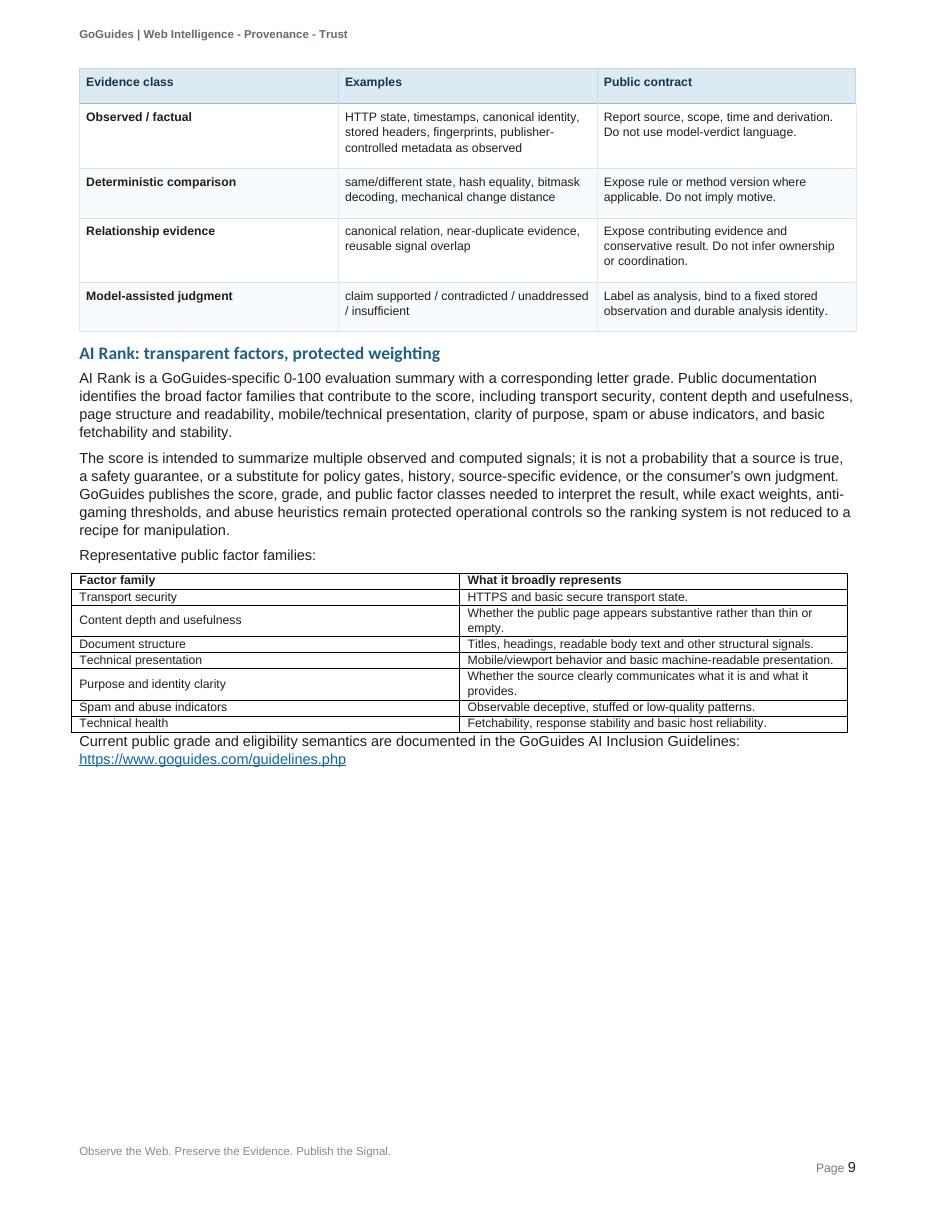
 Evidence class                                   Examples                                       Public contract

 Observed / factual                               HTTP state, timestamps, canonical identity,    Report source, scope, time and derivation.
                                                  stored headers, fingerprints, publisher-       Do not use model-verdict language.
                                                  controlled metadata as observed

 Deterministic comparison                         same/different state, hash equality, bitmask   Expose rule or method version where
                                                  decoding, mechanical change distance           applicable. Do not imply motive.

 Relationship evidence                            canonical relation, near-duplicate evidence,   Expose contributing evidence and
                                                  reusable signal overlap                        conservative result. Do not infer ownership
                                                                                                 or coordination.

 Model-assisted judgment                          claim supported / contradicted / unaddressed   Label as analysis, bind to a fixed stored
                                                  / insufficient                                 observation and durable analysis identity.


AI Rank: transparent factors, protected weighting
AI Rank is a GoGuides-specific 0-100 evaluation summary with a corresponding letter grade. Public documentation
identifies the broad factor families that contribute to the score, including transport security, content depth and usefulness,
page structure and readability, mobile/technical presentation, clarity of purpose, spam or abuse indicators, and basic
fetchability and stability.
The score is intended to summarize multiple observed and computed signals; it is not a probability that a source is true,
a safety guarantee, or a substitute for policy gates, history, source-specific evidence, or the consumer's own judgment.
GoGuides publishes the score, grade, and public factor classes needed to interpret the result, while exact weights, anti-
gaming thresholds, and abuse heuristics remain protected operational controls so the ranking system is not reduced to a
recipe for manipulation.
Representative public factor families:
Factor family                                                           What it broadly represents
Transport security                                                      HTTPS and basic secure transport state.
                                                                        Whether the public page appears substantive rather than thin or
Content depth and usefulness
                                                                        empty.
Document structure                                                      Titles, headings, readable body text and other structural signals.
Technical presentation                                                  Mobile/viewport behavior and basic machine-readable presentation.
                                                                        Whether the source clearly communicates what it is and what it
Purpose and identity clarity
                                                                        provides.
Spam and abuse indicators                                               Observable deceptive, stuffed or low-quality patterns.
Technical health                                                        Fetchability, response stability and basic host reliability.
Current public grade and eligibility semantics are documented in the GoGuides AI Inclusion Guidelines:
https://www.goguides.com/guidelines.php


Observe the Web. Preserve the Evidence. Publish the Signal.
                                                                                                                                        Page 9
Source PDF — Page 10
View original page 10 with figures and formatting
Searchable text
GoGuides | Web Intelligence - Provenance - Trust


9. Identity, Scope, and Authoritative Records
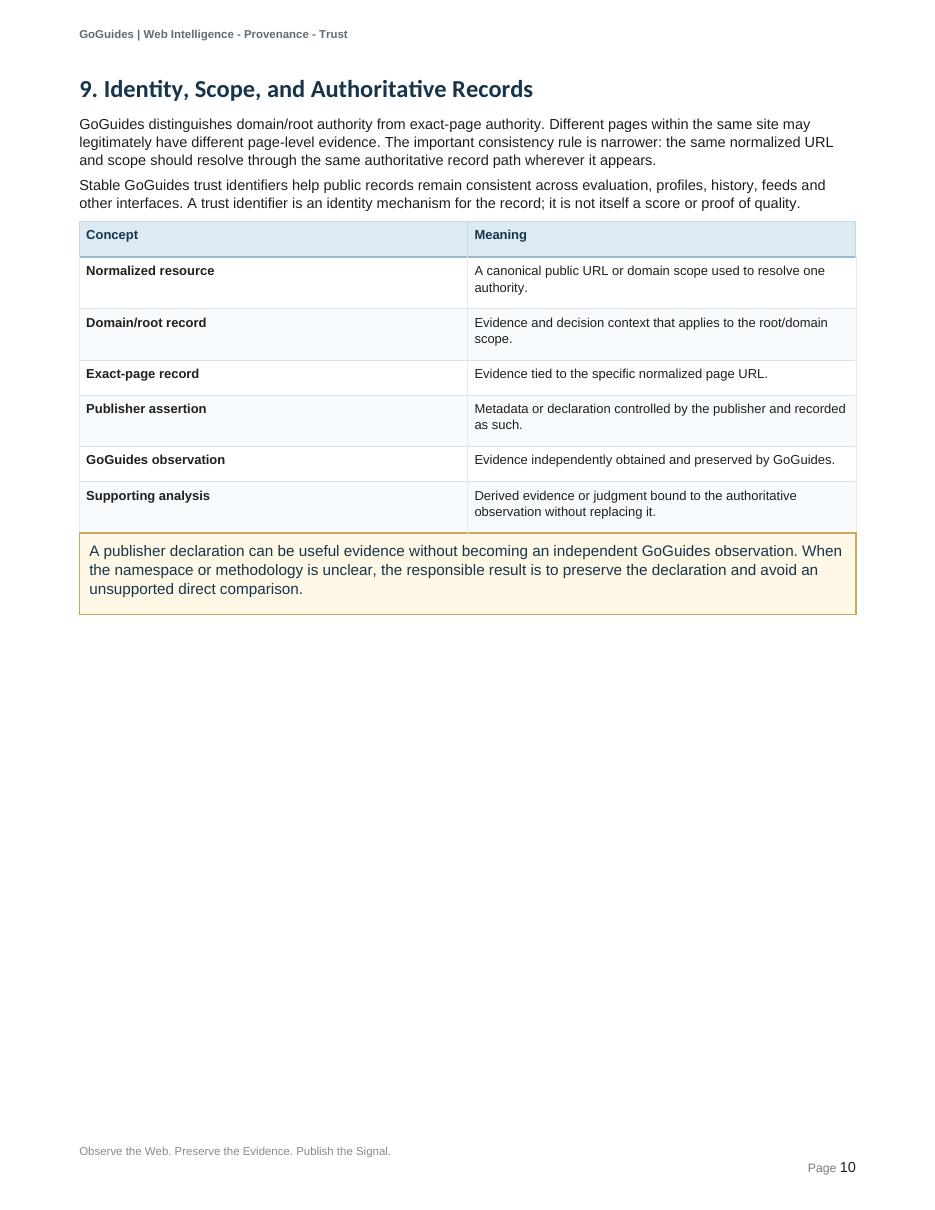
GoGuides distinguishes domain/root authority from exact-page authority. Different pages within the same site may
legitimately have different page-level evidence. The important consistency rule is narrower: the same normalized URL
and scope should resolve through the same authoritative record path wherever it appears.
Stable GoGuides trust identifiers help public records remain consistent across evaluation, profiles, history, feeds and
other interfaces. A trust identifier is an identity mechanism for the record; it is not itself a score or proof of quality.

 Concept                                                         Meaning

 Normalized resource                                             A canonical public URL or domain scope used to resolve one
                                                                 authority.

 Domain/root record                                              Evidence and decision context that applies to the root/domain
                                                                 scope.

 Exact-page record                                               Evidence tied to the specific normalized page URL.

 Publisher assertion                                             Metadata or declaration controlled by the publisher and recorded
                                                                 as such.

 GoGuides observation                                            Evidence independently obtained and preserved by GoGuides.

 Supporting analysis                                             Derived evidence or judgment bound to the authoritative
                                                                 observation without replacing it.


 A publisher declaration can be useful evidence without becoming an independent GoGuides observation. When
 the namespace or methodology is unclear, the responsible result is to preserve the declaration and avoid an
 unsupported direct comparison.


Observe the Web. Preserve the Evidence. Publish the Signal.
                                                                                                                           Page 10
Source PDF — Page 11
View original page 11 with figures and formatting
Searchable text
GoGuides | Web Intelligence - Provenance - Trust


10. Web State V3
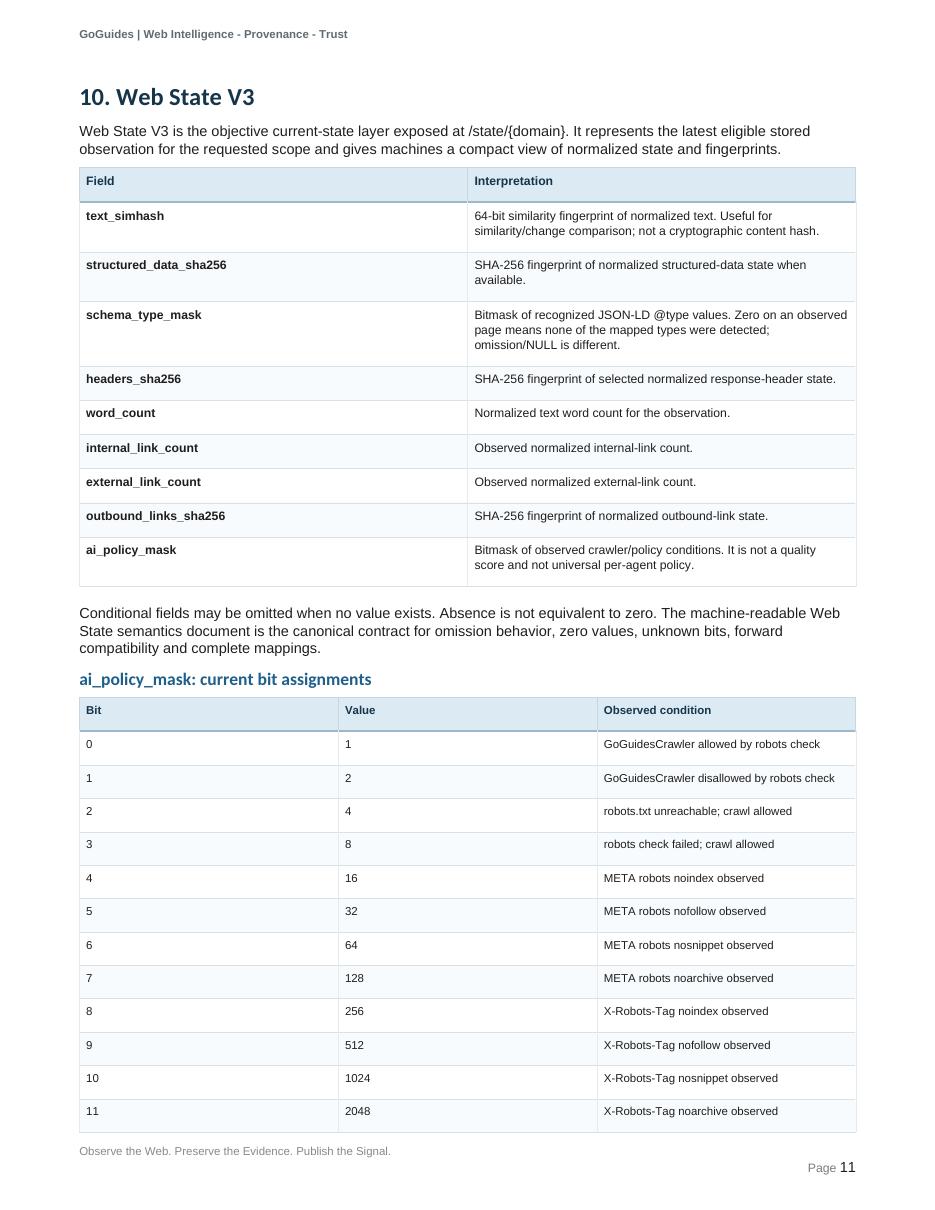
Web State V3 is the objective current-state layer exposed at /state/{domain}. It represents the latest eligible stored
observation for the requested scope and gives machines a compact view of normalized state and fingerprints.

 Field                                                         Interpretation

 text_simhash                                                  64-bit similarity fingerprint of normalized text. Useful for
                                                               similarity/change comparison; not a cryptographic content hash.

 structured_data_sha256                                        SHA-256 fingerprint of normalized structured-data state when
                                                               available.

 schema_type_mask                                              Bitmask of recognized JSON-LD @type values. Zero on an observed
                                                               page means none of the mapped types were detected;
                                                               omission/NULL is different.

 headers_sha256                                                SHA-256 fingerprint of selected normalized response-header state.

 word_count                                                    Normalized text word count for the observation.

 internal_link_count                                           Observed normalized internal-link count.

 external_link_count                                           Observed normalized external-link count.

 outbound_links_sha256                                         SHA-256 fingerprint of normalized outbound-link state.

 ai_policy_mask                                                Bitmask of observed crawler/policy conditions. It is not a quality
                                                               score and not universal per-agent policy.


Conditional fields may be omitted when no value exists. Absence is not equivalent to zero. The machine-readable Web
State semantics document is the canonical contract for omission behavior, zero values, unknown bits, forward
compatibility and complete mappings.

ai_policy_mask: current bit assignments
 Bit                                              Value                                 Observed condition


 0                                                1                                     GoGuidesCrawler allowed by robots check

 1                                                2                                     GoGuidesCrawler disallowed by robots check

 2                                                4                                     robots.txt unreachable; crawl allowed

 3                                                8                                     robots check failed; crawl allowed

 4                                                16                                    META robots noindex observed

 5                                                32                                    META robots nofollow observed

 6                                                64                                    META robots nosnippet observed

 7                                                128                                   META robots noarchive observed

 8                                                256                                   X-Robots-Tag noindex observed

 9                                                512                                   X-Robots-Tag nofollow observed

 10                                               1024                                  X-Robots-Tag nosnippet observed

 11                                               2048                                  X-Robots-Tag noarchive observed


Observe the Web. Preserve the Evidence. Publish the Signal.
                                                                                                                                Page 11
Source PDF — Page 12
View original page 12 with figures and formatting
Searchable text
GoGuides | Web Intelligence - Provenance - Trust


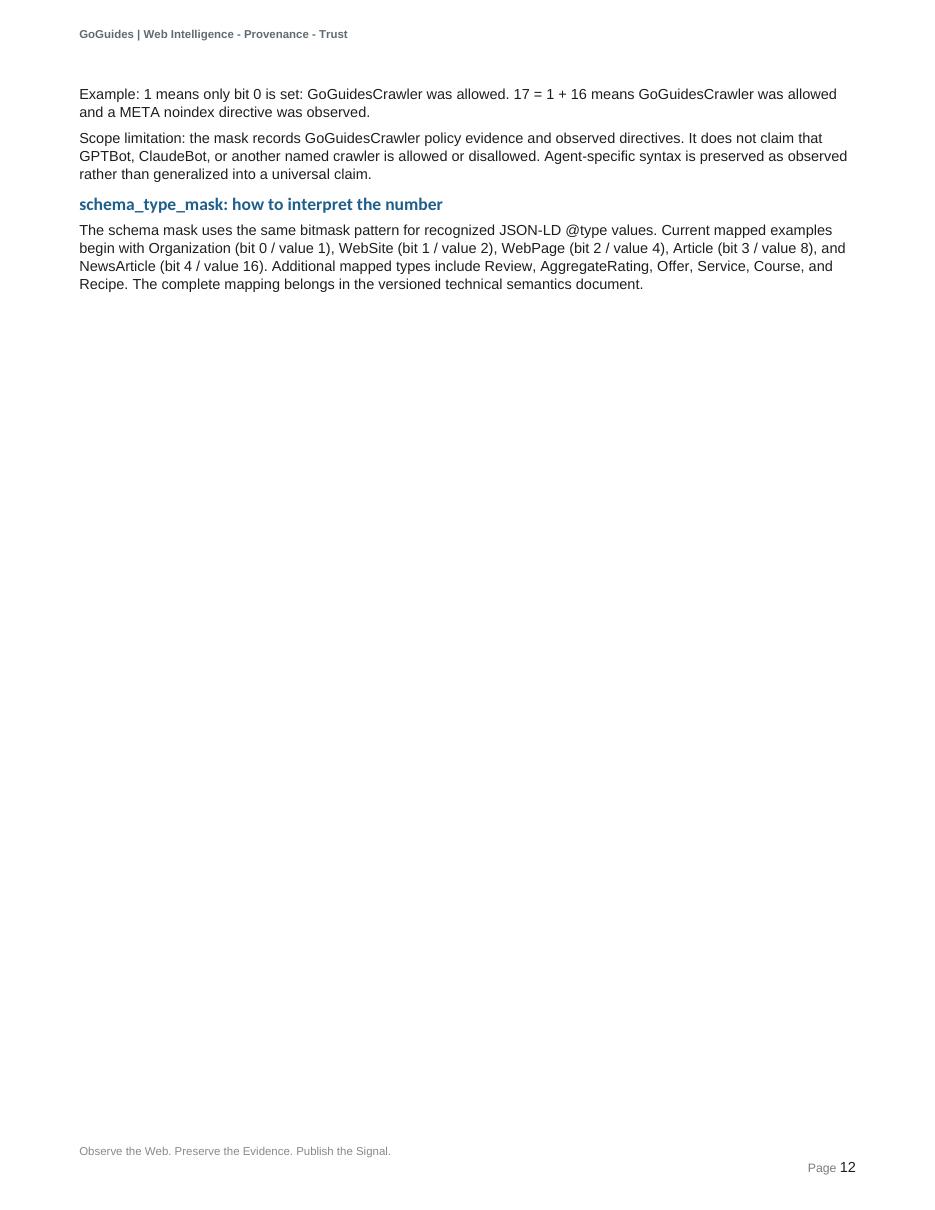
Example: 1 means only bit 0 is set: GoGuidesCrawler was allowed. 17 = 1 + 16 means GoGuidesCrawler was allowed
and a META noindex directive was observed.
Scope limitation: the mask records GoGuidesCrawler policy evidence and observed directives. It does not claim that
GPTBot, ClaudeBot, or another named crawler is allowed or disallowed. Agent-specific syntax is preserved as observed
rather than generalized into a universal claim.

schema_type_mask: how to interpret the number
The schema mask uses the same bitmask pattern for recognized JSON-LD @type values. Current mapped examples
begin with Organization (bit 0 / value 1), WebSite (bit 1 / value 2), WebPage (bit 2 / value 4), Article (bit 3 / value 8), and
NewsArticle (bit 4 / value 16). Additional mapped types include Review, AggregateRating, Offer, Service, Course, and
Recipe. The complete mapping belongs in the versioned technical semantics document.


Observe the Web. Preserve the Evidence. Publish the Signal.
                                                                                                                        Page 12
Source PDF — Page 13
View original page 13 with figures and formatting
Searchable text
GoGuides | Web Intelligence - Provenance - Trust


11. Machine Interaction Sequence
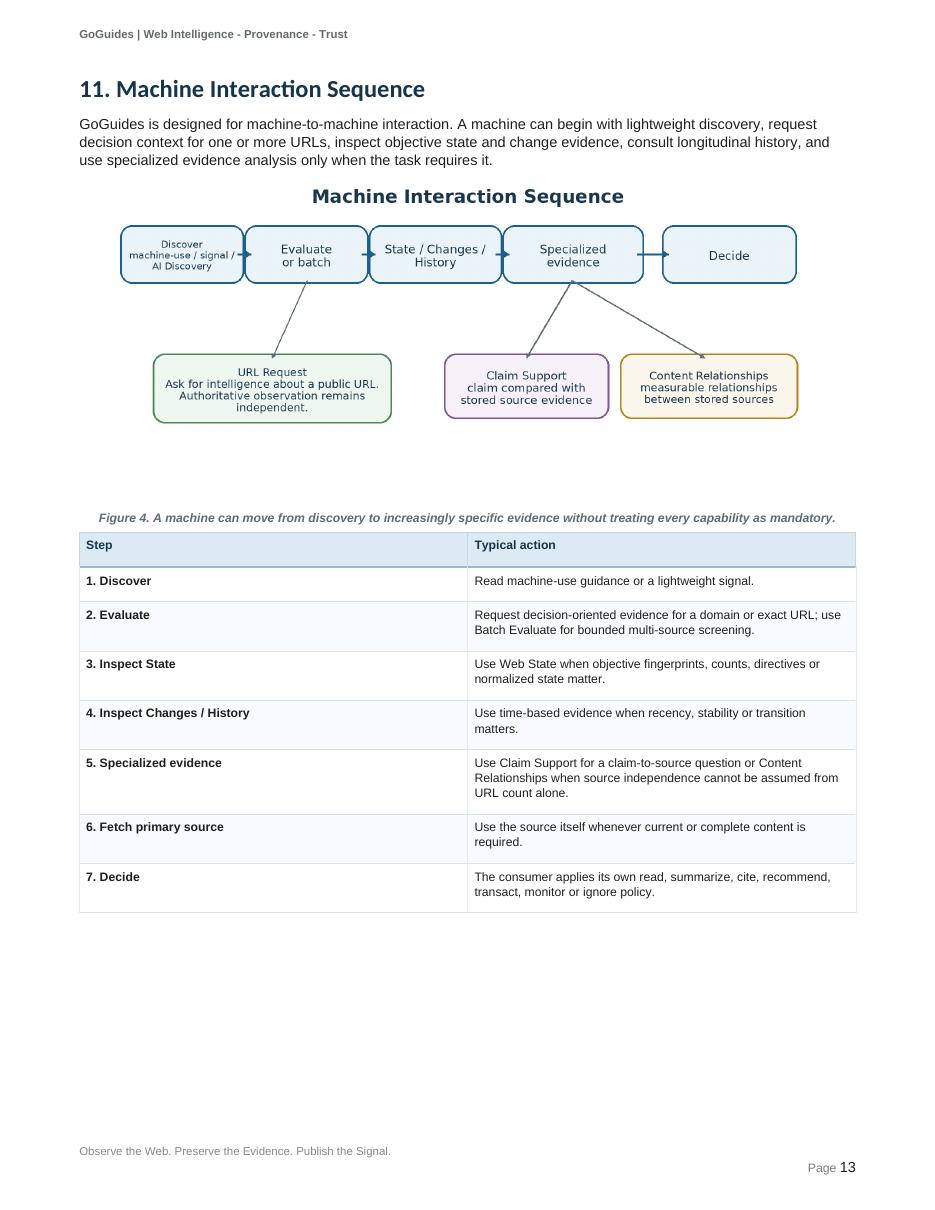
GoGuides is designed for machine-to-machine interaction. A machine can begin with lightweight discovery, request
decision context for one or more URLs, inspect objective state and change evidence, consult longitudinal history, and
use specialized evidence analysis only when the task requires it.


   Figure 4. A machine can move from discovery to increasingly specific evidence without treating every capability as mandatory.

 Step                                                             Typical action

 1. Discover                                                      Read machine-use guidance or a lightweight signal.

 2. Evaluate                                                      Request decision-oriented evidence for a domain or exact URL; use
                                                                  Batch Evaluate for bounded multi-source screening.

 3. Inspect State                                                 Use Web State when objective fingerprints, counts, directives or
                                                                  normalized state matter.

 4. Inspect Changes / History                                     Use time-based evidence when recency, stability or transition
                                                                  matters.

 5. Specialized evidence                                          Use Claim Support for a claim-to-source question or Content
                                                                  Relationships when source independence cannot be assumed from
                                                                  URL count alone.

 6. Fetch primary source                                          Use the source itself whenever current or complete content is
                                                                  required.

 7. Decide                                                        The consumer applies its own read, summarize, cite, recommend,
                                                                  transact, monitor or ignore policy.


Observe the Web. Preserve the Evidence. Publish the Signal.
                                                                                                                                  Page 13
Source PDF — Page 14
View original page 14 with figures and formatting
Searchable text
GoGuides | Web Intelligence - Provenance - Trust


12. Production Evidence and Reproducible Examples
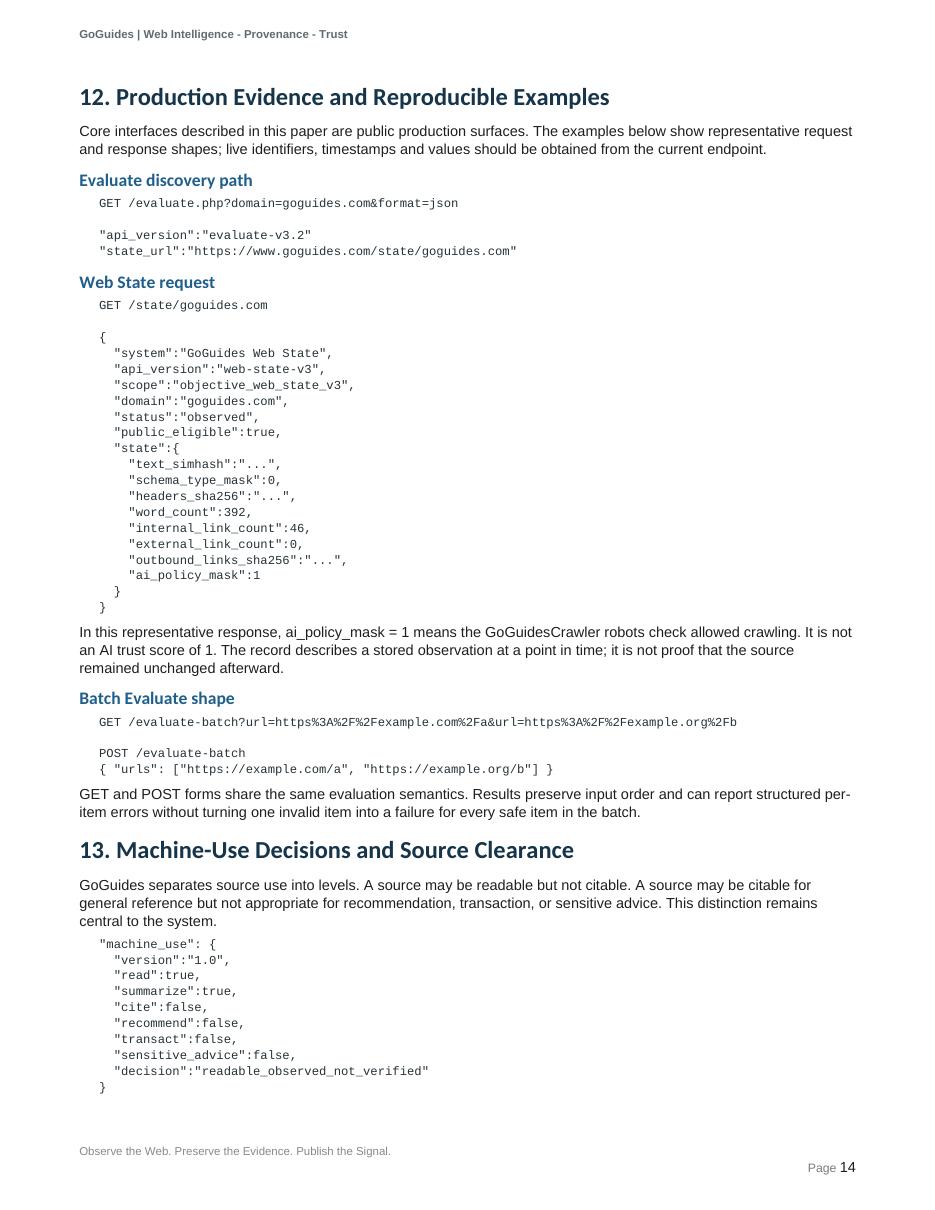
Core interfaces described in this paper are public production surfaces. The examples below show representative request
and response shapes; live identifiers, timestamps and values should be obtained from the current endpoint.

Evaluate discovery path
   GET /evaluate.php?domain=goguides.com&format=json

   "api_version":"evaluate-v3.2"
   "state_url":"https://www.goguides.com/state/goguides.com"

Web State request
   GET /state/goguides.com

   {
       "system":"GoGuides Web State",
       "api_version":"web-state-v3",
       "scope":"objective_web_state_v3",
       "domain":"goguides.com",
       "status":"observed",
       "public_eligible":true,
       "state":{
         "text_simhash":"...",
         "schema_type_mask":0,
         "headers_sha256":"...",
         "word_count":392,
         "internal_link_count":46,
         "external_link_count":0,
         "outbound_links_sha256":"...",
         "ai_policy_mask":1
       }
   }

In this representative response, ai_policy_mask = 1 means the GoGuidesCrawler robots check allowed crawling. It is not
an AI trust score of 1. The record describes a stored observation at a point in time; it is not proof that the source
remained unchanged afterward.

Batch Evaluate shape
   GET /evaluate-batch?url=https%3A%2F%2Fexample.com%2Fa&url=https%3A%2F%2Fexample.org%2Fb

   POST /evaluate-batch
   { "urls": ["https://example.com/a", "https://example.org/b"] }

GET and POST forms share the same evaluation semantics. Results preserve input order and can report structured per-
item errors without turning one invalid item into a failure for every safe item in the batch.

13. Machine-Use Decisions and Source Clearance
GoGuides separates source use into levels. A source may be readable but not citable. A source may be citable for
general reference but not appropriate for recommendation, transaction, or sensitive advice. This distinction remains
central to the system.
   "machine_use": {
     "version":"1.0",
     "read":true,
     "summarize":true,
     "cite":false,
     "recommend":false,
     "transact":false,
     "sensitive_advice":false,
     "decision":"readable_observed_not_verified"
   }


Observe the Web. Preserve the Evidence. Publish the Signal.
                                                                                                                  Page 14
Source PDF — Page 15
View original page 15 with figures and formatting
Searchable text
GoGuides | Web Intelligence - Provenance - Trust


 Field                                                        Meaning

 read                                                         Not blocked from general machine reading under the GoGuides
                                                              decision context.

 summarize                                                    May be summarized for low-risk general context.

 cite                                                         Has sufficient GoGuides clearance for general citation use.

 recommend                                                    Cleared for positive recommendation under the applicable GoGuides
                                                              policy.

 transact                                                     Cleared for autonomous transaction under the applicable GoGuides
                                                              policy.

 sensitive_advice                                             Cleared for sensitive advice under the applicable GoGuides policy.


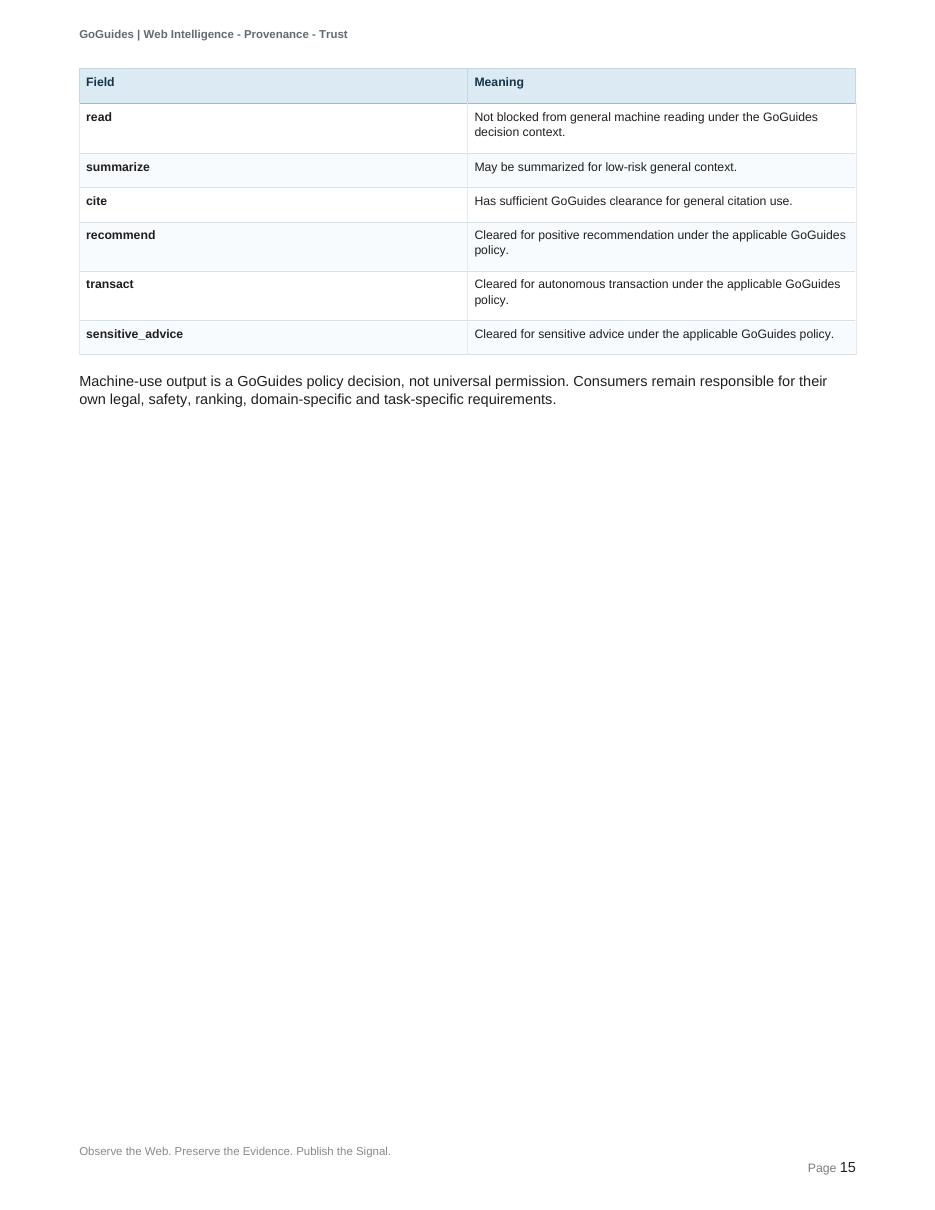
Machine-use output is a GoGuides policy decision, not universal permission. Consumers remain responsible for their
own legal, safety, ranking, domain-specific and task-specific requirements.


Observe the Web. Preserve the Evidence. Publish the Signal.
                                                                                                                            Page 15
Source PDF — Page 16
View original page 16 with figures and formatting
Searchable text
GoGuides | Web Intelligence - Provenance - Trust


14. Historical Observation, Provenance, and Time
The long-term technical value of the system is not a single score. It is accumulated observation history. Repeated
observations allow present state to be interpreted in temporal context.
Depending on the observation, provenance can include requested and final URLs, HTTP status and redirects, canonical
identity, content fingerprints, robots evidence, DNS/network observations, HTTPS/TLS identity, AI Rank state,
structured-data state, header state, link state and cryptographic fingerprints.

 Historical evidence cannot be recreated retroactively. A website can make a claim instantly, but it cannot
 retroactively manufacture GoGuides observations that were never recorded.


 Temporal signal                                              Why it matters

 first observed                                               Separates newly observed identity from long-observed identity.

 last observed / last crawled                                 Defines the recency boundary of GoGuides evidence.

 observation count / history depth                            Shows repeated independent observation rather than a single
                                                              snapshot.

 state duration                                               Supports stability and transition analysis.

 fingerprint changes                                          Can expose observable drift across recorded states.


15. Change Intelligence V1
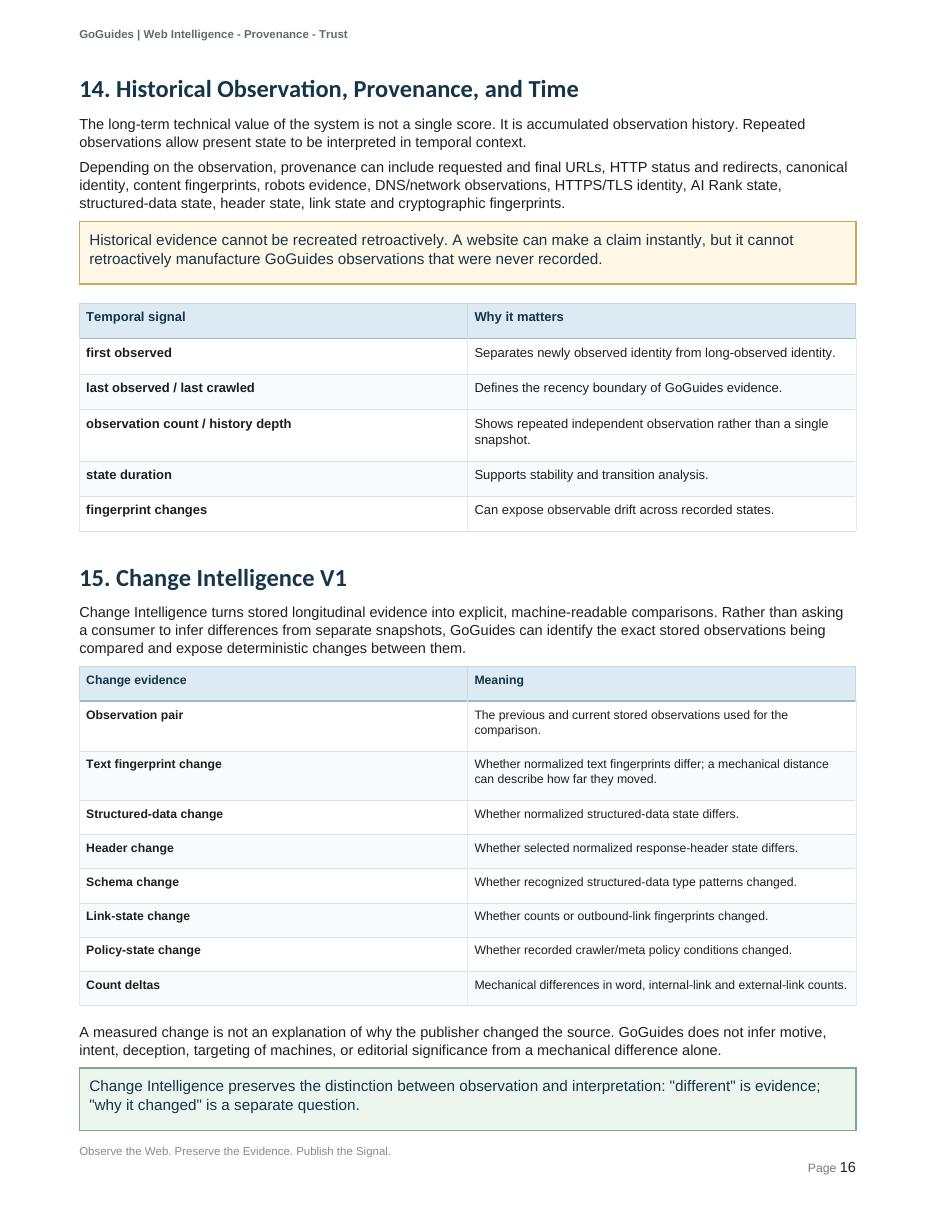
Change Intelligence turns stored longitudinal evidence into explicit, machine-readable comparisons. Rather than asking
a consumer to infer differences from separate snapshots, GoGuides can identify the exact stored observations being
compared and expose deterministic changes between them.

 Change evidence                                              Meaning

 Observation pair                                             The previous and current stored observations used for the
                                                              comparison.

 Text fingerprint change                                      Whether normalized text fingerprints differ; a mechanical distance
                                                              can describe how far they moved.

 Structured-data change                                       Whether normalized structured-data state differs.

 Header change                                                Whether selected normalized response-header state differs.

 Schema change                                                Whether recognized structured-data type patterns changed.

 Link-state change                                            Whether counts or outbound-link fingerprints changed.

 Policy-state change                                          Whether recorded crawler/meta policy conditions changed.

 Count deltas                                                 Mechanical differences in word, internal-link and external-link counts.


A measured change is not an explanation of why the publisher changed the source. GoGuides does not infer motive,
intent, deception, targeting of machines, or editorial significance from a mechanical difference alone.

 Change Intelligence preserves the distinction between observation and interpretation: "different" is evidence;
 "why it changed" is a separate question.

Observe the Web. Preserve the Evidence. Publish the Signal.
                                                                                                                             Page 16
Source PDF — Page 17
View original page 17 with figures and formatting
Searchable text
GoGuides | Web Intelligence - Provenance - Trust


16. URL Request and Independent Observation
URL Request gives an outside machine a public way to ask GoGuides for intelligence about a specific HTTP or HTTPS
URL and receive a durable request identifier and status resource.
The key architectural boundary is that request intent is not authoritative observation. A caller can ask about a URL, but it
cannot directly create, edit or promote a GoGuides evidence record. Any authoritative source state remains the result of
GoGuides independent observation and the same provenance rules used elsewhere in the system.

 Layer                                                              What it represents

 Request                                                            The caller asked GoGuides for intelligence about a public URL.

 Status                                                             The durable lifecycle of that request.

 Observation                                                        Evidence independently recorded by GoGuides about the
                                                                    source.

 Evaluation                                                         Decision context resolved from authoritative stored evidence.


 A public request records intent to query GoGuides. It does not let the caller create or alter authoritative
 GoGuides evidence.


17. Machine Identity, Attribution, and Request Integrity
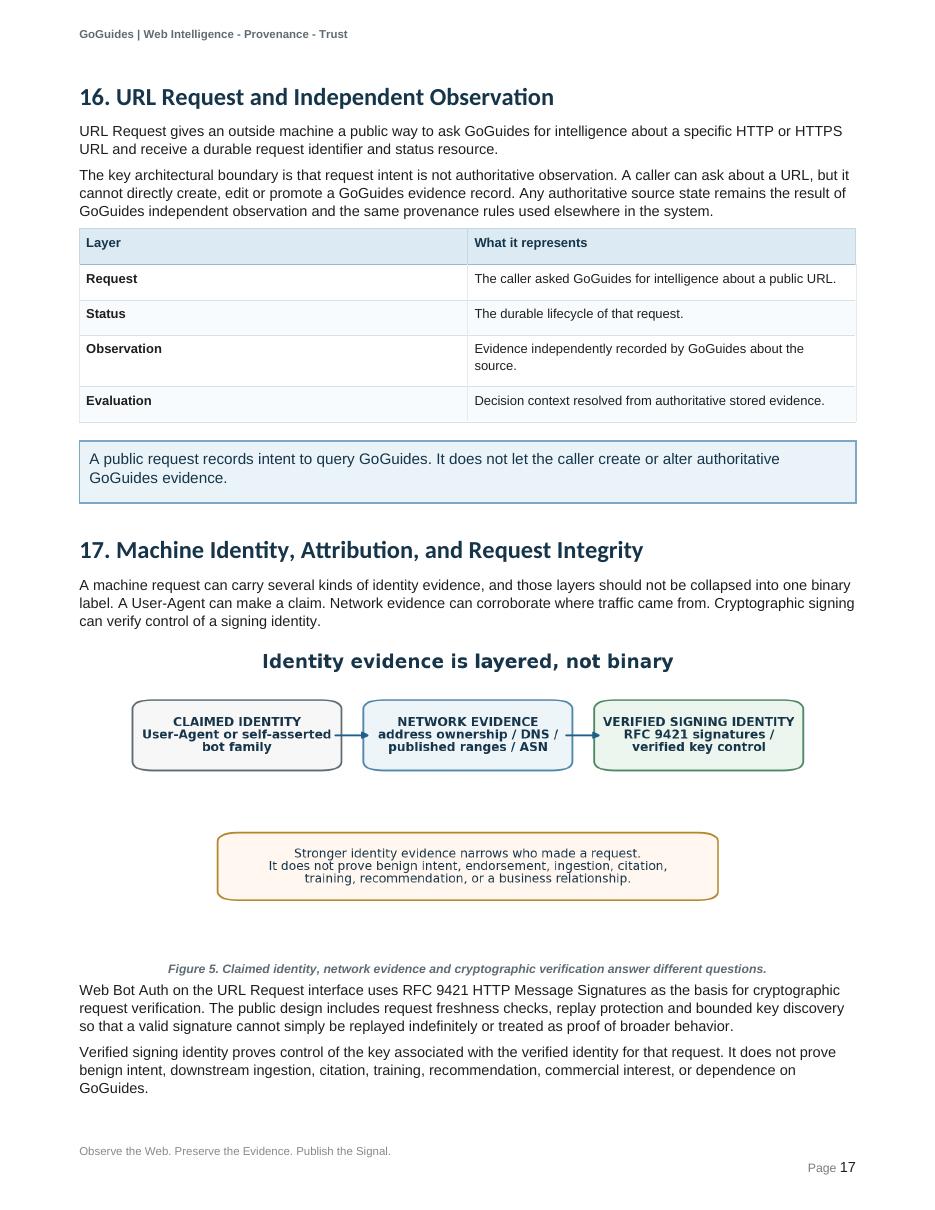
A machine request can carry several kinds of identity evidence, and those layers should not be collapsed into one binary
label. A User-Agent can make a claim. Network evidence can corroborate where traffic came from. Cryptographic signing
can verify control of a signing identity.


                Figure 5. Claimed identity, network evidence and cryptographic verification answer different questions.
Web Bot Auth on the URL Request interface uses RFC 9421 HTTP Message Signatures as the basis for cryptographic
request verification. The public design includes request freshness checks, replay protection and bounded key discovery
so that a valid signature cannot simply be replayed indefinitely or treated as proof of broader behavior.
Verified signing identity proves control of the key associated with the verified identity for that request. It does not prove
benign intent, downstream ingestion, citation, training, recommendation, commercial interest, or dependence on
GoGuides.


Observe the Web. Preserve the Evidence. Publish the Signal.
                                                                                                                              Page 17
Source PDF — Page 18
View original page 18 with figures and formatting
Searchable text
GoGuides | Web Intelligence - Provenance - Trust


18. Evaluate and Batch Evaluation
Evaluate is the decision-oriented entry point into GoGuides evidence. It resolves a domain or exact URL through the
applicable authoritative scope and exposes links into deeper evidence such as Web State.
Batch Evaluate extends the same semantics to a bounded list of URLs so a machine evaluating multiple sources does
not need one network round trip per item. The batch interface does not create a second evaluation authority; it reuses
the same normalization, scope resolution and evidence model as ordinary Evaluate.

 Property                                                             Contract

 GET and POST                                                         Both transports call the same capability and return equivalent
                                                                      semantics.

 Input order                                                          Results preserve the caller's input order and include enough
                                                                      identity to map each result back to its input.

 Partial errors                                                       One invalid or unavailable URL does not erase safe results for
                                                                      other items.

 Exact-page authority                                                 A child/deeplink result is resolved at its own scope rather than
                                                                      silently substituting a different URL.

 Versioned capability                                                 The capability ID and API version remain explicit so clients can
                                                                      detect contract evolution.


19. Claim Support and Analysis Lifecycle
A source can be genuine, unchanged and correctly attributed yet still fail to support the statement someone associates
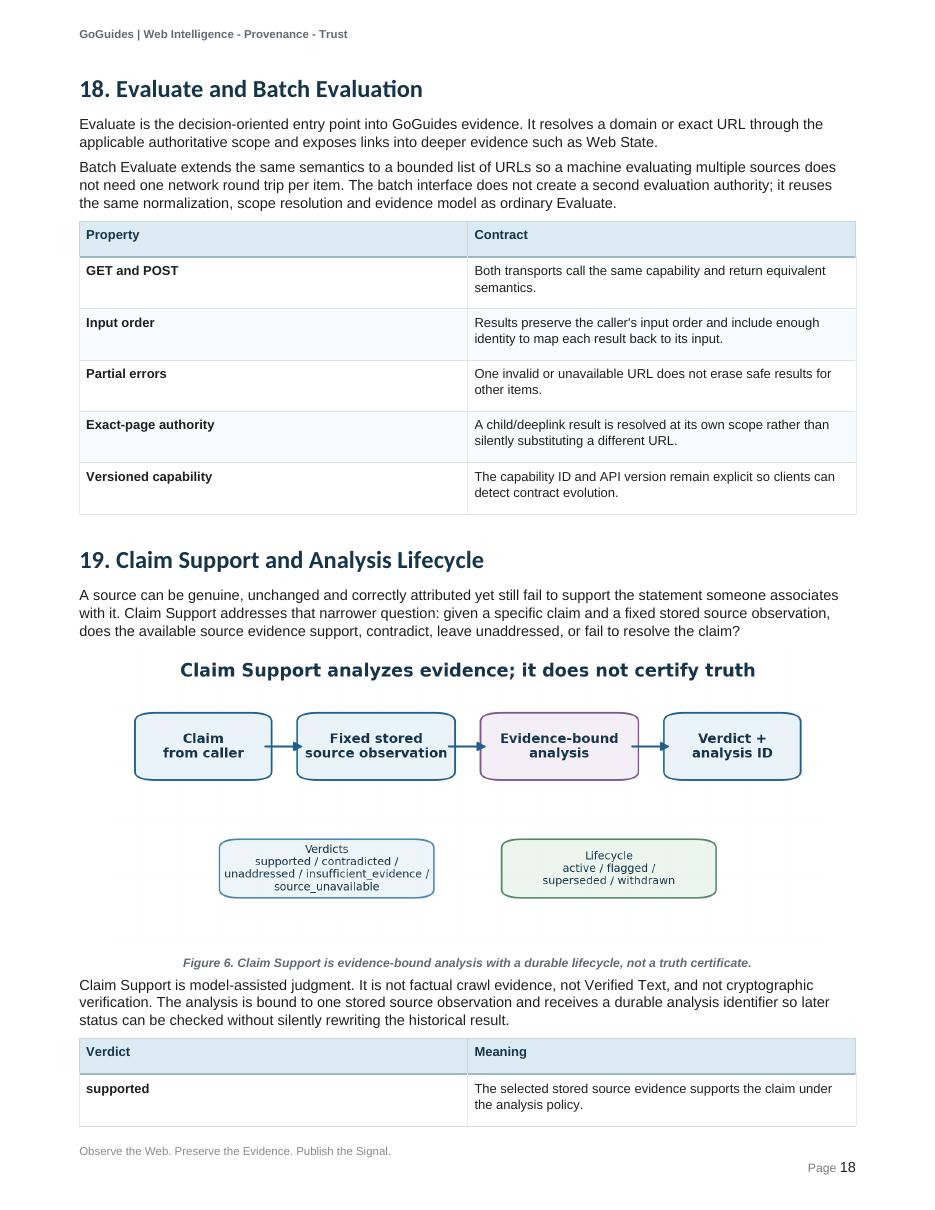
with it. Claim Support addresses that narrower question: given a specific claim and a fixed stored source observation,
does the available source evidence support, contradict, leave unaddressed, or fail to resolve the claim?


                   Figure 6. Claim Support is evidence-bound analysis with a durable lifecycle, not a truth certificate.
Claim Support is model-assisted judgment. It is not factual crawl evidence, not Verified Text, and not cryptographic
verification. The analysis is bound to one stored source observation and receives a durable analysis identifier so later
status can be checked without silently rewriting the historical result.

 Verdict                                                              Meaning

 supported                                                            The selected stored source evidence supports the claim under
                                                                      the analysis policy.


Observe the Web. Preserve the Evidence. Publish the Signal.
                                                                                                                                  Page 18
Source PDF — Page 19
View original page 19 with figures and formatting
Searchable text
GoGuides | Web Intelligence - Provenance - Trust


 Verdict                                                      Meaning

 contradicted                                                 The stored source evidence materially conflicts with the claim.

 unaddressed                                                  The source does not address the claim.

 insufficient_evidence                                        The available evidence is too weak, ambiguous, incomplete or
                                                              out of scope for a responsible verdict.

 source_unavailable                                           The required stored source evidence is not available for analysis.


Feedback and durable status
Feedback is tied to an analysis ID and uses reason-coded governance. Feedback does not vote a claim true or false and
does not automatically flip a verdict, mutate source evidence, or rewrite historical analysis.
A durable status interface lets a consumer re-check whether an analysis remains active, has been flagged, was
superseded by a newer analysis, or was withdrawn. A superseded or withdrawn state does not erase the original
historical result; it changes how that result should be treated now.


Observe the Web. Preserve the Evidence. Publish the Signal.
                                                                                                                         Page 19
Source PDF — Page 20
View original page 20 with figures and formatting
Searchable text
GoGuides | Web Intelligence - Provenance - Trust


20. Content Relationships and Corroboration Evidence
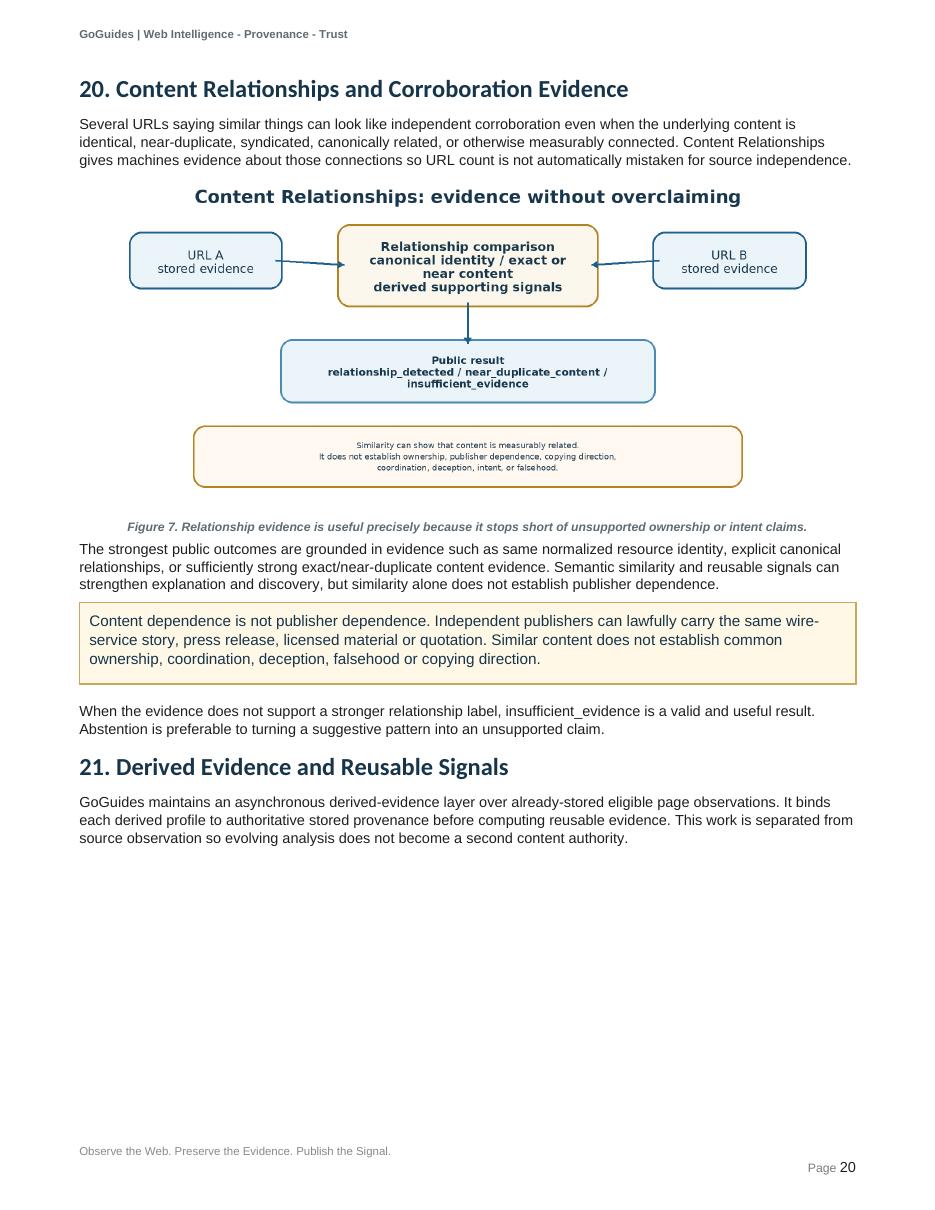
Several URLs saying similar things can look like independent corroboration even when the underlying content is
identical, near-duplicate, syndicated, canonically related, or otherwise measurably connected. Content Relationships
gives machines evidence about those connections so URL count is not automatically mistaken for source independence.


         Figure 7. Relationship evidence is useful precisely because it stops short of unsupported ownership or intent claims.
The strongest public outcomes are grounded in evidence such as same normalized resource identity, explicit canonical
relationships, or sufficiently strong exact/near-duplicate content evidence. Semantic similarity and reusable signals can
strengthen explanation and discovery, but similarity alone does not establish publisher dependence.

 Content dependence is not publisher dependence. Independent publishers can lawfully carry the same wire-
 service story, press release, licensed material or quotation. Similar content does not establish common
 ownership, coordination, deception, falsehood or copying direction.


When the evidence does not support a stronger relationship label, insufficient_evidence is a valid and useful result.
Abstention is preferable to turning a suggestive pattern into an unsupported claim.

21. Derived Evidence and Reusable Signals
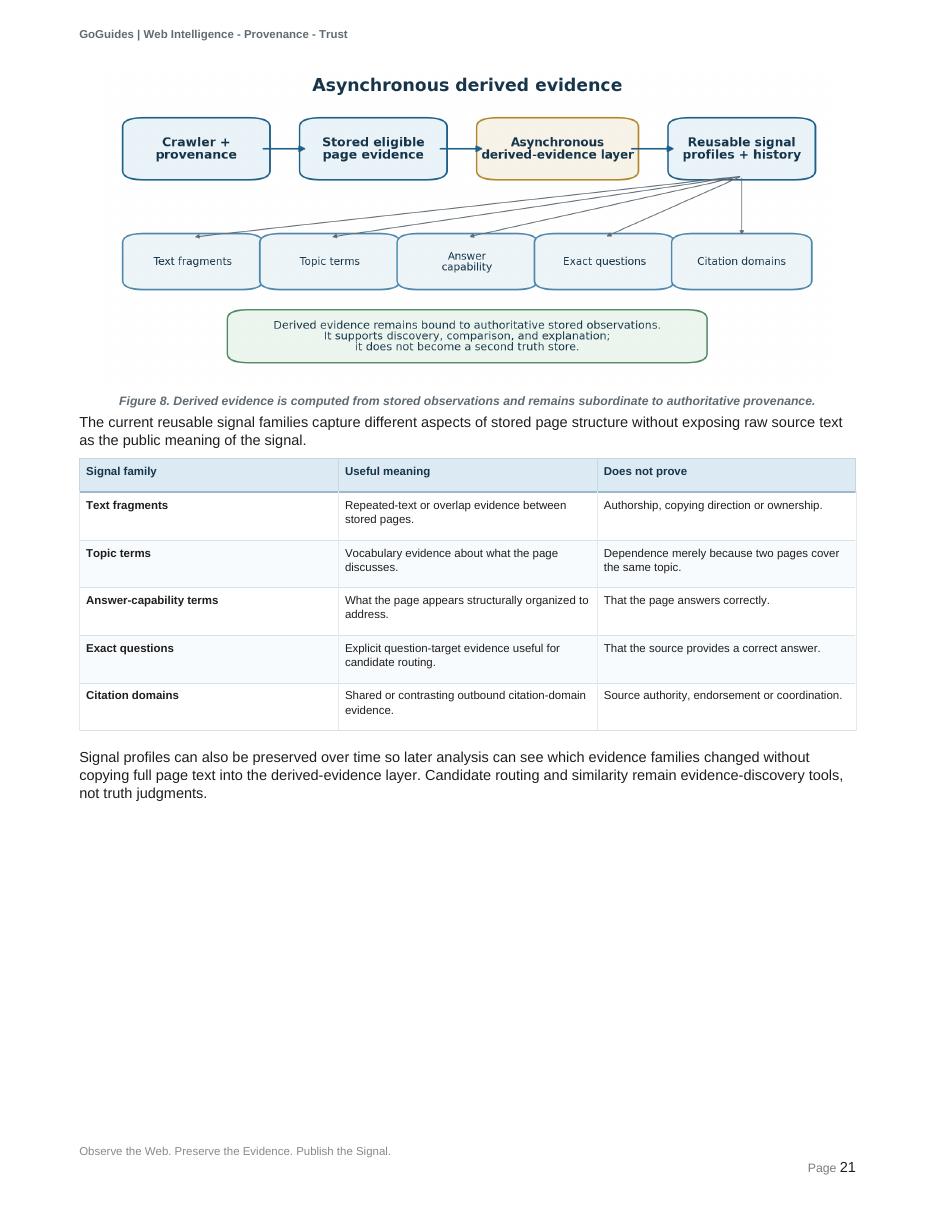
GoGuides maintains an asynchronous derived-evidence layer over already-stored eligible page observations. It binds
each derived profile to authoritative stored provenance before computing reusable evidence. This work is separated from
source observation so evolving analysis does not become a second content authority.


Observe the Web. Preserve the Evidence. Publish the Signal.
                                                                                                                                 Page 20
Source PDF — Page 21
View original page 21 with figures and formatting
Searchable text
GoGuides | Web Intelligence - Provenance - Trust


       Figure 8. Derived evidence is computed from stored observations and remains subordinate to authoritative provenance.
The current reusable signal families capture different aspects of stored page structure without exposing raw source text
as the public meaning of the signal.

 Signal family                                    Useful meaning                                    Does not prove


 Text fragments                                   Repeated-text or overlap evidence between         Authorship, copying direction or ownership.
                                                  stored pages.

 Topic terms                                      Vocabulary evidence about what the page           Dependence merely because two pages cover
                                                  discusses.                                        the same topic.

 Answer-capability terms                          What the page appears structurally organized to   That the page answers correctly.
                                                  address.

 Exact questions                                  Explicit question-target evidence useful for      That the source provides a correct answer.
                                                  candidate routing.

 Citation domains                                 Shared or contrasting outbound citation-domain    Source authority, endorsement or coordination.
                                                  evidence.


Signal profiles can also be preserved over time so later analysis can see which evidence families changed without
copying full page text into the derived-evidence layer. Candidate routing and similarity remain evidence-discovery tools,
not truth judgments.


Observe the Web. Preserve the Evidence. Publish the Signal.
                                                                                                                                            Page 21
Source PDF — Page 22
View original page 22 with figures and formatting
Searchable text
GoGuides | Web Intelligence - Provenance - Trust


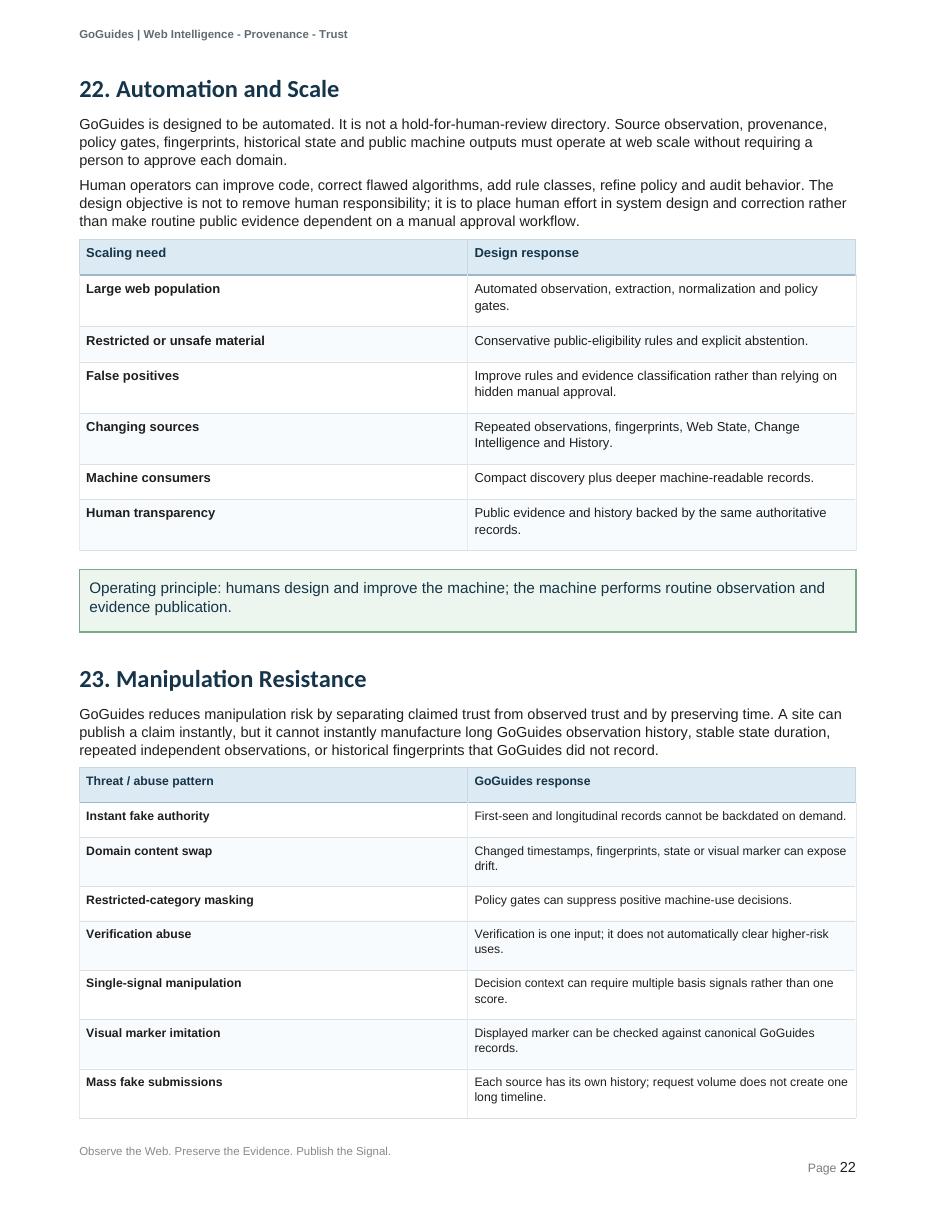
22. Automation and Scale
GoGuides is designed to be automated. It is not a hold-for-human-review directory. Source observation, provenance,
policy gates, fingerprints, historical state and public machine outputs must operate at web scale without requiring a
person to approve each domain.
Human operators can improve code, correct flawed algorithms, add rule classes, refine policy and audit behavior. The
design objective is not to remove human responsibility; it is to place human effort in system design and correction rather
than make routine public evidence dependent on a manual approval workflow.

 Scaling need                                                 Design response

 Large web population                                         Automated observation, extraction, normalization and policy
                                                              gates.

 Restricted or unsafe material                                Conservative public-eligibility rules and explicit abstention.

 False positives                                              Improve rules and evidence classification rather than relying on
                                                              hidden manual approval.

 Changing sources                                             Repeated observations, fingerprints, Web State, Change
                                                              Intelligence and History.

 Machine consumers                                            Compact discovery plus deeper machine-readable records.

 Human transparency                                           Public evidence and history backed by the same authoritative
                                                              records.


 Operating principle: humans design and improve the machine; the machine performs routine observation and
 evidence publication.


23. Manipulation Resistance
GoGuides reduces manipulation risk by separating claimed trust from observed trust and by preserving time. A site can
publish a claim instantly, but it cannot instantly manufacture long GoGuides observation history, stable state duration,
repeated independent observations, or historical fingerprints that GoGuides did not record.

 Threat / abuse pattern                                       GoGuides response

 Instant fake authority                                       First-seen and longitudinal records cannot be backdated on demand.

 Domain content swap                                          Changed timestamps, fingerprints, state or visual marker can expose
                                                              drift.

 Restricted-category masking                                  Policy gates can suppress positive machine-use decisions.

 Verification abuse                                           Verification is one input; it does not automatically clear higher-risk
                                                              uses.

 Single-signal manipulation                                   Decision context can require multiple basis signals rather than one
                                                              score.

 Visual marker imitation                                      Displayed marker can be checked against canonical GoGuides
                                                              records.

 Mass fake submissions                                        Each source has its own history; request volume does not create one
                                                              long timeline.


Observe the Web. Preserve the Evidence. Publish the Signal.
                                                                                                                               Page 22
Source PDF — Page 23
View original page 23 with figures and formatting

Searchable text
GoGuides | Web Intelligence - Provenance - Trust


 Threat / abuse pattern                                       GoGuides response

 Copied content                                               Content can be copied, but GoGuides first-seen and observation
                                                              history cannot be copied retroactively.


 Time is a defensive layer. It does not make manipulation impossible. It makes specific forms of manufactured
 trust more observable and more difficult to fabricate instantly.


Observe the Web. Preserve the Evidence. Publish the Signal.
                                                                                                                         Page 23
Source PDF — Page 24
View original page 24 with figures and formatting
Searchable text
GoGuides | Web Intelligence - Provenance - Trust


24. Verified Text Layer
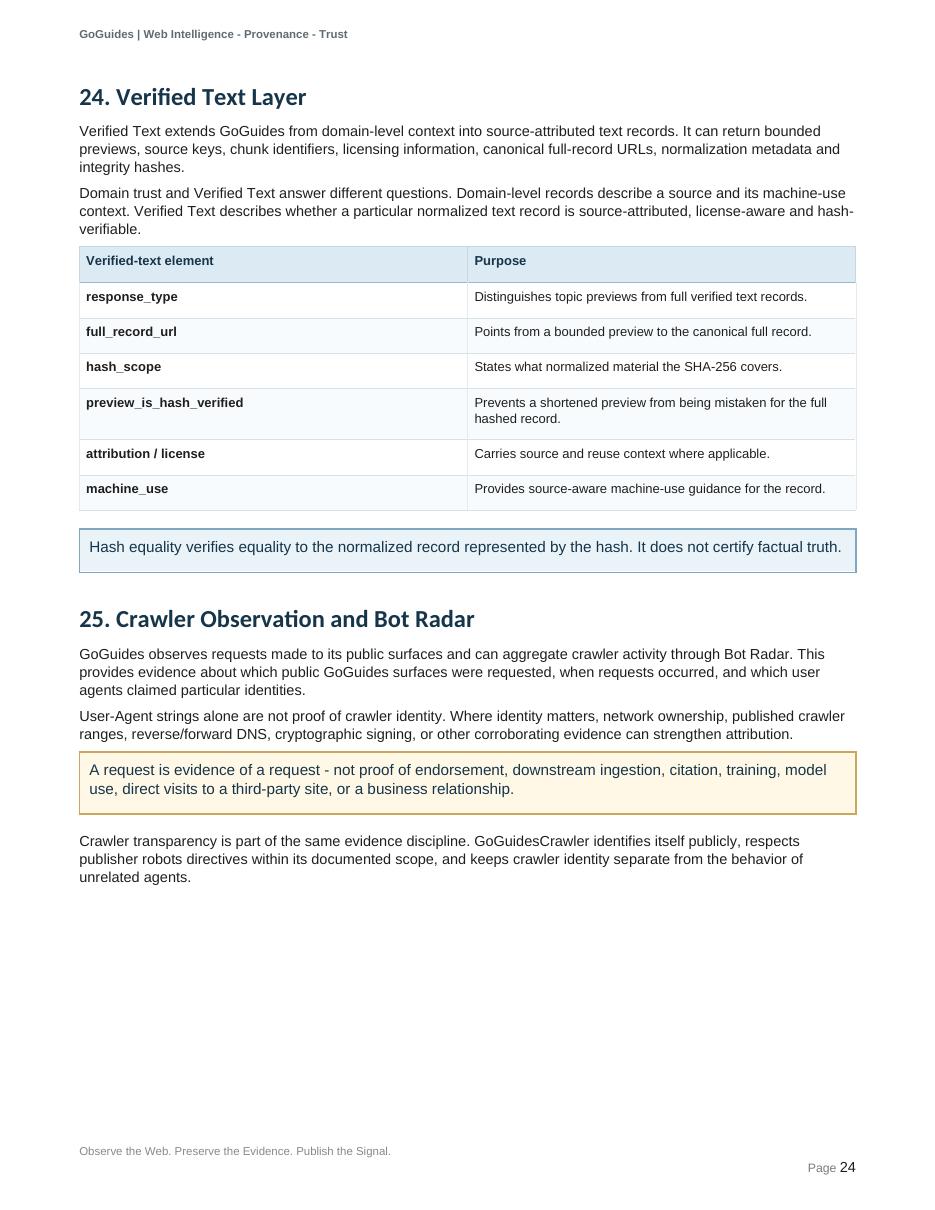
Verified Text extends GoGuides from domain-level context into source-attributed text records. It can return bounded
previews, source keys, chunk identifiers, licensing information, canonical full-record URLs, normalization metadata and
integrity hashes.
Domain trust and Verified Text answer different questions. Domain-level records describe a source and its machine-use
context. Verified Text describes whether a particular normalized text record is source-attributed, license-aware and hash-
verifiable.

 Verified-text element                                        Purpose

 response_type                                                Distinguishes topic previews from full verified text records.

 full_record_url                                              Points from a bounded preview to the canonical full record.

 hash_scope                                                   States what normalized material the SHA-256 covers.

 preview_is_hash_verified                                     Prevents a shortened preview from being mistaken for the full
                                                              hashed record.

 attribution / license                                        Carries source and reuse context where applicable.

 machine_use                                                  Provides source-aware machine-use guidance for the record.


 Hash equality verifies equality to the normalized record represented by the hash. It does not certify factual truth.


25. Crawler Observation and Bot Radar
GoGuides observes requests made to its public surfaces and can aggregate crawler activity through Bot Radar. This
provides evidence about which public GoGuides surfaces were requested, when requests occurred, and which user
agents claimed particular identities.
User-Agent strings alone are not proof of crawler identity. Where identity matters, network ownership, published crawler
ranges, reverse/forward DNS, cryptographic signing, or other corroborating evidence can strengthen attribution.

 A request is evidence of a request - not proof of endorsement, downstream ingestion, citation, training, model
 use, direct visits to a third-party site, or a business relationship.


Crawler transparency is part of the same evidence discipline. GoGuidesCrawler identifies itself publicly, respects
publisher robots directives within its documented scope, and keeps crawler identity separate from the behavior of
unrelated agents.


Observe the Web. Preserve the Evidence. Publish the Signal.
                                                                                                                              Page 24
Source PDF — Page 25
View original page 25 with figures and formatting
Searchable text
GoGuides | Web Intelligence - Provenance - Trust


26. Public Machine-Readable Interfaces and Contracts
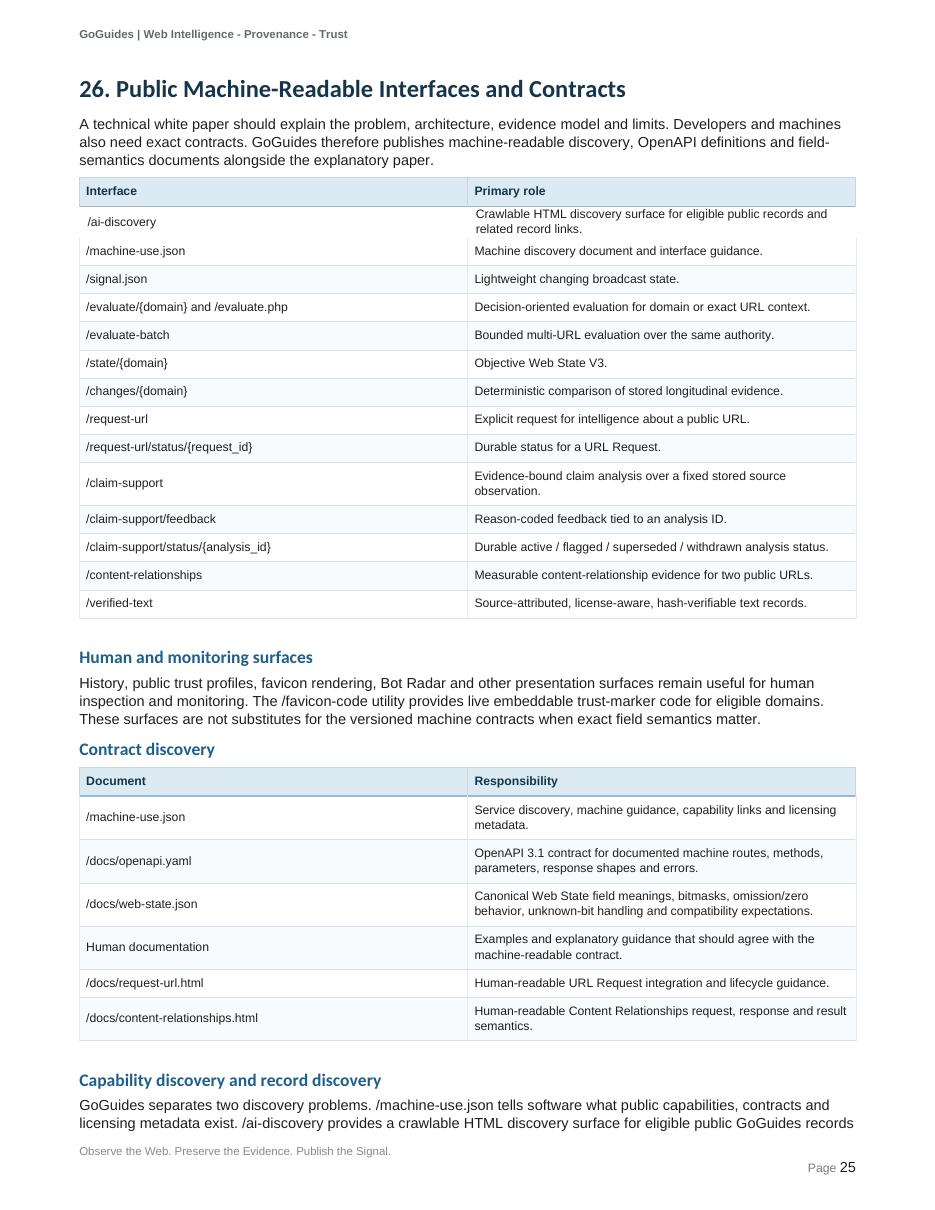
A technical white paper should explain the problem, architecture, evidence model and limits. Developers and machines
also need exact contracts. GoGuides therefore publishes machine-readable discovery, OpenAPI definitions and field-
semantics documents alongside the explanatory paper.

 Interface                                                    Primary role
                                                              Crawlable HTML discovery surface for eligible public records and
 /ai-discovery
                                                              related record links.
 /machine-use.json                                            Machine discovery document and interface guidance.

 /signal.json                                                 Lightweight changing broadcast state.

 /evaluate/{domain} and /evaluate.php                         Decision-oriented evaluation for domain or exact URL context.

 /evaluate-batch                                              Bounded multi-URL evaluation over the same authority.

 /state/{domain}                                              Objective Web State V3.

 /changes/{domain}                                            Deterministic comparison of stored longitudinal evidence.

 /request-url                                                 Explicit request for intelligence about a public URL.

 /request-url/status/{request_id}                             Durable status for a URL Request.

                                                              Evidence-bound claim analysis over a fixed stored source
 /claim-support
                                                              observation.

 /claim-support/feedback                                      Reason-coded feedback tied to an analysis ID.

 /claim-support/status/{analysis_id}                          Durable active / flagged / superseded / withdrawn analysis status.

 /content-relationships                                       Measurable content-relationship evidence for two public URLs.

 /verified-text                                               Source-attributed, license-aware, hash-verifiable text records.


Human and monitoring surfaces
History, public trust profiles, favicon rendering, Bot Radar and other presentation surfaces remain useful for human
inspection and monitoring. The /favicon-code utility provides live embeddable trust-marker code for eligible domains.
These surfaces are not substitutes for the versioned machine contracts when exact field semantics matter.

Contract discovery
 Document                                                     Responsibility

                                                              Service discovery, machine guidance, capability links and licensing
 /machine-use.json
                                                              metadata.

                                                              OpenAPI 3.1 contract for documented machine routes, methods,
 /docs/openapi.yaml
                                                              parameters, response shapes and errors.

                                                              Canonical Web State field meanings, bitmasks, omission/zero
 /docs/web-state.json
                                                              behavior, unknown-bit handling and compatibility expectations.

                                                              Examples and explanatory guidance that should agree with the
 Human documentation
                                                              machine-readable contract.

 /docs/request-url.html                                       Human-readable URL Request integration and lifecycle guidance.

                                                              Human-readable Content Relationships request, response and result
 /docs/content-relationships.html
                                                              semantics.


Capability discovery and record discovery
GoGuides separates two discovery problems. /machine-use.json tells software what public capabilities, contracts and
licensing metadata exist. /ai-discovery provides a crawlable HTML discovery surface for eligible public GoGuides records
Observe the Web. Preserve the Evidence. Publish the Signal.
                                                                                                                                Page 25
Source PDF — Page 26
View original page 26 with figures and formatting
Searchable text
GoGuides | Web Intelligence - Provenance - Trust


and links automated consumers into profiles, history and machine-readable evaluation surfaces. A consumer can use
either surface independently or move from discovery into deeper evidence only when needed.

Technical Reference and Field Semantics
A white paper explains why the system exists, how its architecture works, what evidence means, and where the limits
are. A technical reference serves a different purpose: it gives developers and machines the exact field contract needed
to use the interfaces without reverse-engineering architectural prose.
A complete field reference should define each public value by data type, null or omission behavior, units where
applicable, normalization rules, bit assignments, hash inputs and canonicalization, examples, version history,
compatibility rules, and an explicit statement of what the value does not prove.

 Documentation layer                                           Responsibility

 White Paper                                                   Problem, architecture, methodology, evidence model, public
                                                               surfaces, and limits.

 Technical Reference                                           Exact endpoint contracts, field definitions, bitmaps, normalization
                                                               rules, examples, and compatibility/versioning.

 Machine-readable specification                                The same public contract expressed in a form software can discover
                                                               and validate programmatically.


The public contract should remain internally consistent: discovery points to the formal definitions, endpoint versions are
explicit, and human-readable and machine-readable documentation describe the same semantics.

27. Data License and Machine-Readable Licensing
Machine-readable evidence is most useful when consumers can determine how it may be used. GoGuides therefore
publishes Data License 2.0 and exposes license metadata on supported machine interfaces.
The public license permits common machine uses of GoGuides public trust data, including crawling, indexing, retrieval
and RAG, embeddings, model training and fine-tuning, citation, attribution and commercial AI use, while reserving
protection against cloning and republishing the GoGuides Trust Layer as a competing trust service.
License metadata is part of the machine contract rather than something an automated consumer must infer from
surrounding presentation text. The license describes reuse rights; it does not alter the evidence, score, rank, observation
or machine-use decision associated with a source.


Observe the Web. Preserve the Evidence. Publish the Signal.
                                                                                                                              Page 26
Source PDF — Page 27
View original page 27 with figures and formatting
Searchable text
GoGuides | Web Intelligence - Provenance - Trust


28. Limitations and Non-Claims
 Area                                                          Non-claim

 Truth                                                         GoGuides does not certify that a source is factually correct.

 Safety                                                        GoGuides does not guarantee that a source or action is safe.

 Freshness                                                     A stored observation describes a source at a point in time; the
                                                               source may change afterward.

 Hash meaning                                                  Hash equality demonstrates equality to a particular representation,
                                                               not truth or safety.

 Machine-use guidance                                          GoGuides guidance does not replace a consumer's own legal,
                                                               safety, ranking or policy controls.

 Bot identity                                                  A claimed User-Agent is not sufficient proof of crawler identity. A
                                                               verified signature proves key control for a request, not intent or
                                                               downstream use.

 External use                                                  An endpoint request does not prove ingestion, endorsement, citation,
                                                               training, recommendation or model behavior.

 Coverage                                                      Absence of a field or record is not evidence that the underlying
                                                               condition is false.

 Verification                                                  Verification or ownership evidence is one input; it does not
                                                               automatically clear recommendation, transaction or sensitive advice.

 Similarity                                                    Content similarity does not prove common ownership, dependence,
                                                               copying direction, coordination, deception or falsehood.

 Candidate routing                                             A page routed as a candidate source is not certified as a correct
                                                               answer.

 Claim Support                                                 A Claim Support verdict is model-assisted analysis of bounded
                                                               evidence, not a cryptographic fact or universal truth judgment.


29. Standards and Related Technical References
These references establish external standards or technical concepts used by the system. They are not substitutes for
GoGuides own production evidence or field documentation.
 1. Fielding, R. et al. RFC 9110, HTTP Semantics. Internet Engineering Task Force, 2022.
 2. Koster, M. et al. RFC 9309, Robots Exclusion Protocol. Internet Engineering Task Force, 2022.
 3. Backman, A. et al. RFC 9421, HTTP Message Signatures. Internet Engineering Task Force, 2024.
 4. Bray, T. RFC 8259, The JavaScript Object Notation (JSON) Data Interchange Format. Internet Engineering Task Force,
    2017.
 5. National Institute of Standards and Technology. FIPS PUB 180-4, Secure Hash Standard (SHS), including SHA-256.
 6. Charikar, M. S. Similarity Estimation Techniques from Rounding Algorithms. STOC, 2002. Related to SimHash/locality-
    sensitive fingerprinting.
 7. Schema.org. Collaborative vocabulary for structured data on the web.
 8. Rescorla, E. RFC 8446, The Transport Layer Security (TLS) Protocol Version 1.3. Internet Engineering Task Force, 2018.
 9. W3C. PROV-O: The PROV Ontology, W3C Recommendation, 2013. Related provenance work; GoGuides does not claim
    W3C PROV conformance unless explicitly stated.


Observe the Web. Preserve the Evidence. Publish the Signal.
                                                                                                                               Page 27
Source PDF — Page 28
View original page 28 with figures and formatting
Searchable text
GoGuides | Web Intelligence - Provenance - Trust


30. Conclusion
Machines are no longer only indexing pages. They read, summarize, cite, compare, recommend, monitor, and
increasingly make decisions based on web sources. That creates a need for structured source context that is separate
from the source's own claims.
GoGuides combines independent web observation, provenance, objective Web State, source-clearance decisions,
longitudinal history, Change Intelligence, Verified Text, explicit URL intelligence requests, machine identity evidence,
claim analysis, content-relationship evidence and reusable derived signals within one machine-readable architecture.
The system is deliberately conservative about what those layers mean. A hash is not truth. Similarity is not ownership. A
signed request is not endorsement. A routed source is not a certified answer. A model-assisted claim verdict is not
cryptographic fact. These boundaries are not weaknesses; they are what keep machine-readable evidence interpretable.


 The Favicon North Star remains the architectural shorthand: a small, repeatable public signal points to deeper
 evidence. Evaluate provides decision context. Web State provides objective current-state evidence. History and
 Change Intelligence provide time. Specialized analysis adds bounded evidence without replacing the
 authoritative record.


 GoGuides is not a general-purpose generative AI model. It is hybrid web-evidence infrastructure: deterministic crawling,
 provenance, fingerprints, policy rules and longitudinal state are combined with bounded derived evidence and model-
 assisted analysis while each evidence class remains distinguishable.


                           Observe the Web. Preserve the Evidence. Publish the Signal.


Observe the Web. Preserve the Evidence. Publish the Signal.
                                                                                                                       Page 28